
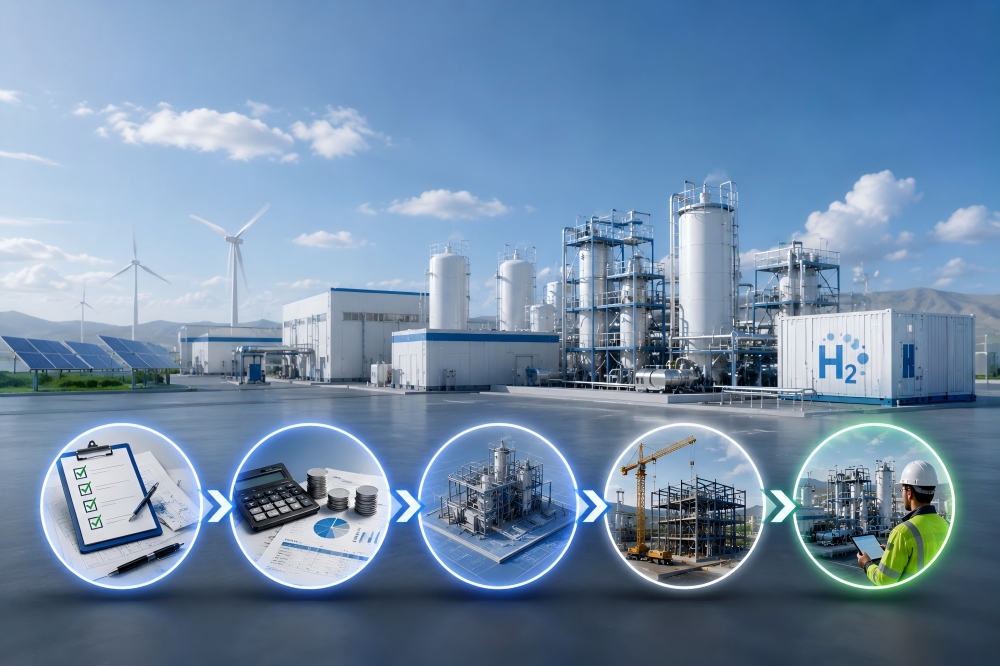
Planning a hydrogen generator project feels overwhelming. You face technology choices, site constraints, and budget pressures. But a well‑planned hydrogen generator project delivers lower hydrogen costs and supply security for decades.
This guide walks you through five proven steps for any hydrogen generator project. You will learn how to size your system, pick the right technology, avoid common mistakes, and calculate your real payback.
For a complete overview of our hydrogen generator systems, visit: Hydrogen Generator Solutions
Step 1: Define Your Hydrogen Demand Profile
Every successful hydrogen generator project starts with accurate demand data. You need three numbers.
Average daily consumption tells you your baseline. Peak hourly demand determines your maximum required flow. Minimum night or weekend demand helps you avoid oversizing.
Many hydrogen generator projects fail because buyers only look at averages. They install a system sized for average load, then struggle to meet peak demand. The solution? Size for your peak hourly demand. Use storage or multiple smaller units to handle low‑demand periods.
Example: A metal heat‑treatment plant uses 120 Nm³/h during two shifts and 30 Nm³/h overnight. A fixed‑output hydrogen generator project sized for 120 Nm³/h would waste energy running at 25% load at night. A better design: two 60 Nm³/h units. Run one at night, both during the day.
For a real‑world example of demand profiling, read our case study: How a Gas Distributor Doubled Its Hydrogen Margin
Step 2: Choose the Right Technology for Your Hydrogen Generator Project
Your hydrogen generator project has three main technology options. Each fits different situations.
| Technology | Best for | Avoid if |
|---|---|---|
| Methanol reforming | 500‑20,000 Nm³/h, no cheap electricity, want CO₂ revenue | You have renewable power below $0.04/kWh |
| PEM electrolysis | Ultra‑high purity, green hydrogen certification, variable power | Electricity above $0.07/kWh |
| Alkaline electrolysis | Very large scale (>20,000 Nm³/h), lowest upfront cost | Frequent start‑stop cycles |
For a typical industrial hydrogen generator project in a factory or chemical plant, methanol reforming often gives the fastest payback. Why? It does not depend on cheap electricity. It starts and stops in minutes. And it produces concentrated CO₂ that you can sell – adding a second revenue stream.
Read our detailed technology comparison: PEM vs Alkaline vs Methanol Reforming
Step 3: Assess Your Site and Utilities
A successful hydrogen generator project needs four site resources.
1. Space. A 100 Nm³/h methanol reformer fits in a 20‑foot container – about 30 square metres. Add 20 m² for a methanol tank and another 20 m² for CO₂ storage if you capture it. Most factories have this space in a yard or near a loading dock.
2. Methanol supply. You need a reliable source of high‑purity methanol. Sulphur and chlorine must stay below 0.5 ppm. Methanol arrives by tanker truck and stores in a double‑walled tank. Plan deliveries every 1‑4 weeks based on your consumption.
3. Water and power. A methanol‑based hydrogen generator project needs deionised water – about 0.5 m³ per 1,000 Nm³ of hydrogen. Power consumption stays low, typically 15‑30 kW for a 100 Nm³/h unit. A standard three‑phase connection works.
4. Hydrogen off‑take connection. Run a pipe from the generator to your point of use. The generator delivers hydrogen at 0.9‑1.3 MPa. If your process needs higher pressure (e.g., 5 MPa for cylinder filling), add a small compressor.
For a detailed site checklist, download our free guide: 5 Things to Check Before Installing a Hydrogen Generator
Step 4: Calculate the Real Economics of Your Hydrogen Generator Project
A hydrogen generator project is not about the purchase price. It is about total cost of ownership. Use this simple formula.
Total annual cost = (Methanol cost + electricity + water + maintenance) × operating hours + annualised CAPEX
Example for a 100 Nm³/h methanol reformer running 8,000 hours per year:
| Cost item | Calculation | Annual amount |
|---|---|---|
| Methanol | 55 kg/h × 8,000 h × $0.40/kg | $176,000 |
| Electricity | 20 kW × 8,000 h × $0.10/kWh | $16,000 |
| Water and maintenance | Fixed $5,000 | $5,000 |
| CAPEX (amortised over 10 years) | $200,000 ÷ 10 | $20,000 |
| Total annual cost | $217,000 |
Now compare to delivered hydrogen at $0.80 per Nm³:
Delivered cost = 100 Nm³/h × 8,000 h × 0.80=640,000
Annual saving = 640,000–640,000–217,000 = $423,000
Payback period = 200,000÷200,000÷423,000 = 5.7 months
Your numbers will vary with local methanol and electricity prices. We offer a free custom ROI model for your hydrogen generator project. Contact us with your current hydrogen purchase price and volume.
For real numbers from an operating site, read: Hydrogen Generator Price: CAPEX, OPEX and Hidden Savings
Step 5: Plan Your Implementation Timeline
A well‑executed hydrogen generator project takes 4‑6 months from order to operation.
| Phase | Duration | Key activities |
|---|---|---|
| Feasibility and engineering | 4‑6 weeks | Site survey, utility design, permits |
| Equipment manufacturing | 12‑16 weeks | Skid‑mounted generator, PSA, CO₂ module |
| Site preparation | 2‑4 weeks (parallel) | Concrete pad, methanol tank, piping |
| Delivery and installation | 1‑2 weeks | Crane offload, set on pad, connect utilities |
| Commissioning and training | 1‑2 weeks | Start‑up, performance test, operator training |
The longest lead item is usually a custom methanol tank. Order it early to avoid delays.
Five Common Mistakes in Hydrogen Generator Projects
Mistake 1: Sizing for average demand only
Fix: Size for your peak hourly demand. Use storage or multiple generators for low‑demand periods.
Mistake 2: Ignoring CO₂ capture
Fix: A methanol‑based hydrogen generator project produces high‑purity CO₂ as a byproduct. Add a capture module. The revenue from selling CO₂ often covers 20‑30% of your methanol cost.
Mistake 3: Assuming all methanol is the same
Fix: Specify low‑sulphur, low‑chlorine methanol. Impurities kill your catalyst and raise operating costs.
Mistake 4: Forgetting about water treatment
Fix: Include a deionised water system in your scope. Tap water scales heat exchangers and ruins the reformer.
Mistake 5: No remote monitoring
Fix: Insist on a generator with cloud‑based monitoring. You should see production, alerts, and tank levels from your phone.
Common Questions About Hydrogen Generator Projects
Q: How long does a hydrogen generator last?
15‑20 years with regular maintenance. The catalyst needs replacement every 24,000 hours (about 3 years). PEM stacks last 40,000‑60,000 hours.
Q: Do I need a dedicated operator for my hydrogen generator project?
No. Our systems run unattended. They start and stop automatically based on demand. Alerts go to your maintenance team by email or SMS.
Q: Can I add CO₂ capture later?
Yes. The capture module bolts on. Many customers start without capture and add it when they find a CO₂ buyer or when carbon pricing makes it economic.
Q: What safety certifications do I need?
Look for ATEX or IECEx for electrical components, PED for pressure vessels, and ISO 22734 for the complete hydrogen generator. Our systems carry all three.
Q: How much floor space does a 100 Nm³/h unit need?
About 30 m² for the generator plus 20 m² for a methanol tank and 20 m² for CO₂ storage. All can sit outdoors on a concrete pad.
Q: What is the typical delivery time?
12‑16 weeks for standard skid‑mounted units. Add 2‑4 weeks for site preparation and installation.
Q: How do I start a hydrogen generator project at my facility?
Contact our engineering team. We will ask about your hydrogen demand, site conditions, and current hydrogen cost. Then we will send you a custom feasibility study and fixed‑price quote within two weeks.
Ready to Start Your Hydrogen Generator Project?
Every hydrogen generator project is unique. Your hydrogen demand, site conditions, and local energy prices shape the optimal solution. Our engineering team can help you:
- Run a feasibility study with your actual numbers
- Recommend the right technology and size
- Provide a fixed‑price EPC quote including installation and training
- Support you with remote monitoring and long‑term maintenance
Contact us today to discuss your project.
Explore more resources for your hydrogen generator project: Hydrogen Generator Safety Checklist