
You have read about hydrogen generators. You know the theory. But you keep asking yourself one question: does this actually work for a gas distributor like me?
Yes. Let us show you.
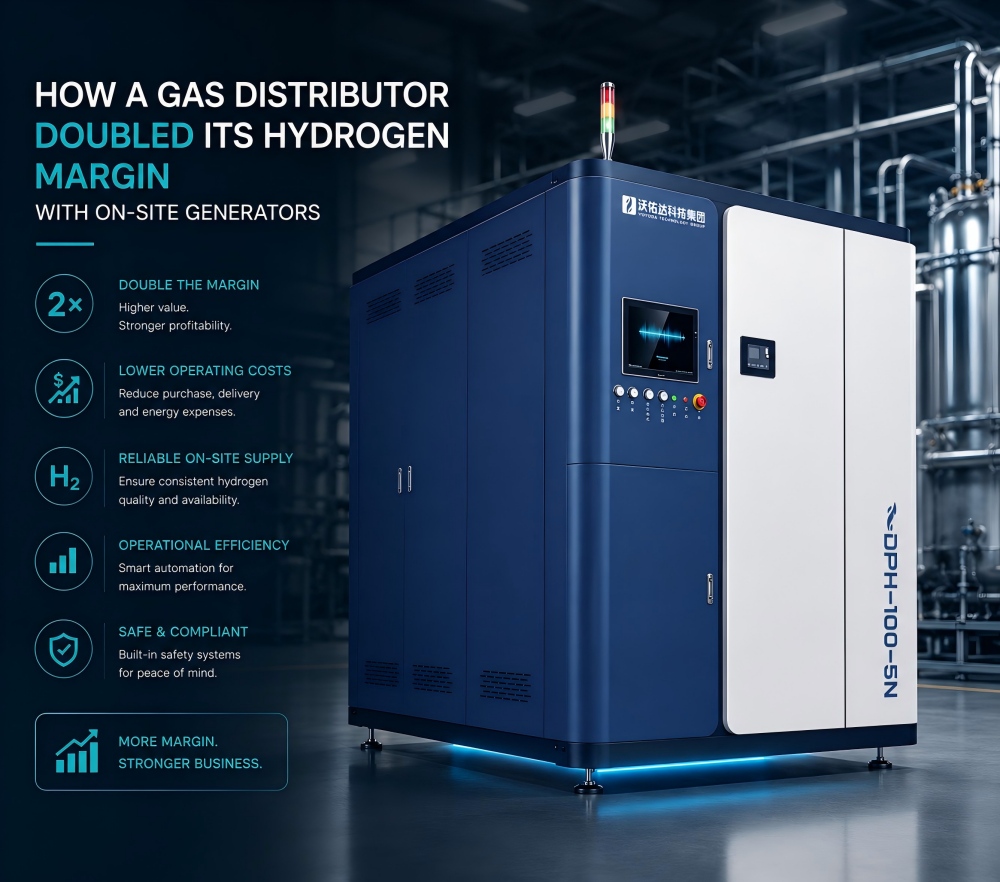
This is the story of a real gas distributor in Southeast Asia. They used to buy liquid hydrogen from a large producer and resell it to local factories. Margins were thin. Logistics were a headache. Then they switched to on‑site hydrogen generation. Within 18 months, their hydrogen margin doubled.
Here is exactly how they did it. And why you might want to copy them.
The Customer: A Mid‑Sized Gas Distributor
We will call them “GasCo”. They had been in the industrial gas business for over 20 years. They sold oxygen, nitrogen, argon, and hydrogen to about 50 customers in a 200‑km radius.
Hydrogen was always a problem. Their upstream supplier raised prices twice a year. Delivery trucks arrived late. Cylinders often came back with contamination. GasCo made only 12% margin on hydrogen.
Their biggest customer was a glass plant using 200 Nm³ of hydrogen per hour. Another was a metal treating shop using 80 Nm³/h. Both complained about high costs and unreliable supply.
For a full review of how on‑site hydrogen generators work, read our guide: On‑Site Hydrogen Generators: Grow Your Gas Business.
The Problem: Thin Margins and Unhappy Customers
GasCo’s numbers looked like this before the change.
| Cost item | Per Nm³ H₂ |
|---|---|
| Purchase price from supplier | $0.48 |
| Transport and cylinder rental | $0.12 |
| Total cost to GasCo | $0.60 |
| Selling price to customer | $0.68 |
| Gross margin | $0.08 (12%) |
That $0.08 per Nm³ had to cover sales, admin, and overhead. Profit was almost nothing.
Worse, the glass plant threatened to switch to another supplier. They wanted a cheaper, more stable hydrogen source. GasCo risked losing its largest customer.
The Solution: Two On‑Site Methanol‑Based Hydrogen Generators
GasCo decided to try something different. Instead of buying hydrogen, they would make their own.
They installed two YPH‑250 units at their own distribution yard. Each unit produces 250 Nm³ of 99.999% pure hydrogen per hour. Total capacity 500 Nm³/h.
The YPH series is designed for large hydrogen demand (150‑500 Nm³/h). It uses methanol reforming with PSA purification. The system fits in a 20‑foot container footprint – about 30 m² per unit.
GasCo also added a 30,000‑liter methanol storage tank and a small CO₂ capture module. They started buying methanol in bulk at $400 per metric ton.
Total investment: $520,000 including installation and training.
For methanol storage details, read our guide: Methanol Supply for On‑Site Hydrogen Generators: What Gas Distributors Must Know.
The Results: Doubled Margins and Happy Customers
After three months of operation, GasCo’s numbers changed completely.
| Cost item | Per Nm³ H₂ |
|---|---|
| Methanol (0.55 kg/Nm³ at $400/ton) | $0.22 |
| Electricity, water, maintenance | $0.04 |
| Total production cost | $0.26 |
| Selling price to customer | $0.68 |
| Gross margin | $0.42 (62%) |
That is not a typo. Gross margin jumped from 0.08to0.42 per Nm³. GasCo now makes over five times more profit on every unit of hydrogen they sell.
And they did not raise prices. They kept the same $0.68 per Nm³. Their customers were delighted.
Payback period: GasCo runs the generators 8,000 hours per year. Annual hydrogen sales: 500 Nm³/h × 8,000 h = 4 million Nm³. At 0.42marginperNm3,annualgrossprofit=1.68 million.
Subtract operating overhead and loan payments. Net profit still paid off the $520,000 investment in less than 5 months.
A Second Revenue Stream: CO₂ Sales
Here is an extra bonus. Every Nm³ of hydrogen from methanol produces about 0.5 kg of CO₂. GasCo’s generators produce 2,000 kg of CO₂ per hour. That is 16,000 tons per year.
GasCo added our CO₂ capture module to purify the byproduct to 5N grade (99.999% pure). They now sell liquid CO₂ to local beverage manufacturers and welding shops for $200 per ton.
That adds another $3.2 million in annual revenue. Even after capture and purification costs, the CO₂ stream alone almost covers the entire equipment investment.
What GasCo’s Owner Told Us
“I wish we had done this five years earlier. Our customers are happier. Our drivers are not rushing to make emergency deliveries. And my accountant finally smiles when we review the hydrogen numbers.”
They have since added a third YPH‑250 at another yard. They now supply hydrogen to 12 new customers who previously bought from other distributors. GasCo’s market share in their region grew from 18% to 34% in two years.
Could You Do the Same?
Your numbers may differ. Methanol prices vary. Electricity costs differ. Your local hydrogen selling price may be higher or lower.
But the math works in almost every market. On‑site hydrogen generation using methanol typically cuts your hydrogen cost in half or more. Add a CO₂ capture stream and your profit margin can easily double or triple.
The hardest part is making the first move. Once you have your first generator running, the rest is easy.
For a deeper look at the safety and reliability of these systems, read: Hydrogen Generator Safety: 7 Critical Checks Before Installation.
Common Questions from Gas Distributors Reading This Case Study
Q: What if I cannot afford the upfront investment?
GasCo financed their equipment through a bank loan. The monthly loan payment was much smaller than their monthly savings from eliminating hydrogen purchases. Many of our customers also lease the equipment or use a hydrogen‑as‑a‑service model where we own the generator and they pay only for the hydrogen.
Q: Do I need a special building for the generators?
No. The YPH‑250 comes in a weatherproof, skid‑mounted enclosure rated for outdoor installation. GasCo placed them on a concrete pad next to their existing cylinder filling area.
Q: How many people do I need to run the generators?
Zero dedicated operators. The systems run fully automatically. GasCo’s yard manager checks the dashboard once per day. They receive alerts if anything needs attention. One part‑time technician handles maintenance.
Q: What about methanol spills or safety concerns?
Methanol is less flammable than gasoline. It requires basic precautions: double‑walled tank, spill containment, and grounding during transfers. GasCo passed all local fire inspections with no issues.
Q: How long do the generators last?
Over 15 years with regular maintenance. The catalyst needs replacement every 24,000 hours (about three years). GasCo already budgeted for that and still enjoys healthy margins.
Q: Can I start with one smaller generator to test the model?
Absolutely. Many of our customers begin with a DPH series (15‑100 Nm³/h) for a single large customer. Once they see the results, they add more units. GasCo started with two YPH‑250, but you can start much smaller.
Ready to Run Your Own Numbers?
Every gas distributor’s situation is unique. Your customer base, local methanol price, and hydrogen selling price will determine your exact payback period.
But the trend is clear. Distributors who switch to on‑site generation lock in lower costs, higher margins, and happier customers. Those who wait will keep struggling with thin profits and supply risks.
Let us help you calculate your own potential savings. Our team will ask you a few questions about your current hydrogen volume and costs. We will send you a customized projection within two business days.
Want to understand the methanol supply side in more detail? Read our guide: Methanol Supply for On‑Site Hydrogen Generators.