
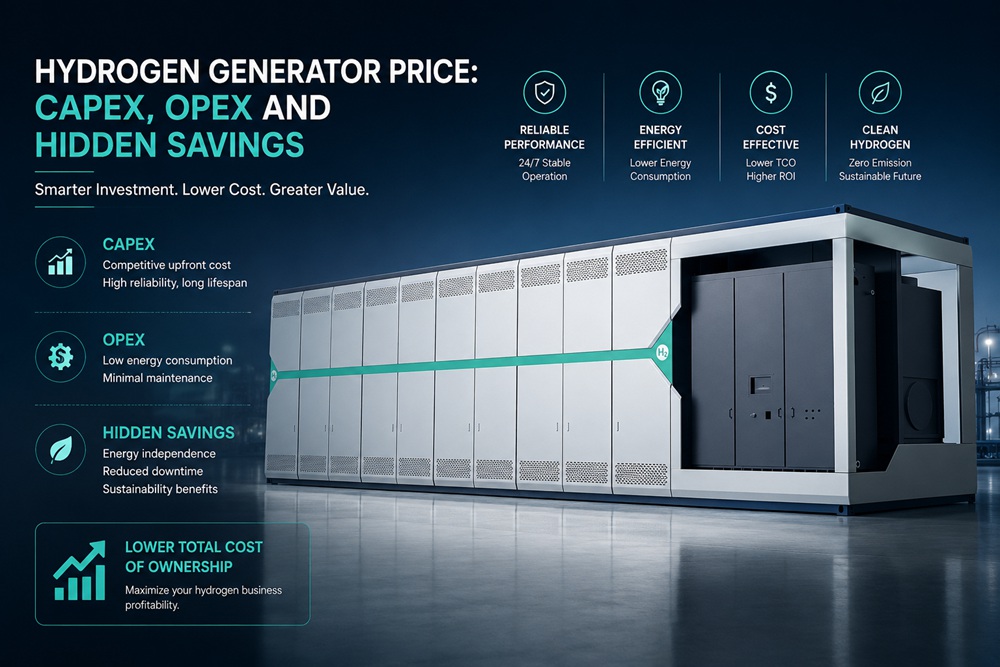
You see a price tag on a hydrogen generator. That number tells you almost nothing. The real cost of owning a hydrogen generator includes what you pay upfront, what you spend each year to run it, and the savings you never see on any invoice.
This guide breaks down hydrogen generator price into three parts. You will learn what drives the initial purchase cost. You will see how operating expenses add up. And you will discover the hidden savings that make on‑site hydrogen cheaper than delivered gas.
Part 1: CAPEX – What You Pay to Buy the Machine
The upfront hydrogen generator price depends on three things: technology type, size, and features.
Technology choice matters most.
Methanol‑based reformers cost less than PEM electrolyzers. A 100 Nm³/h methanol reformer typically runs 150,000to250,000 installed. The same capacity PEM system runs 400,000to600,000.
Why the gap? Methanol reformers use simpler materials. No expensive membranes. No precious metal catalysts like platinum or iridium. The reactor vessel and heat exchangers are standard industrial components.
Size scales the price.
A small DPH series unit (15‑100 Nm³/h) costs less than a large YPH series unit (150‑500 Nm³/h). Bigger capacity means bigger vessels, more catalyst, and larger heat exchangers. But the price per unit of hydrogen usually drops as you go bigger.
Features add cost but pay back quickly.
A basic hydrogen generator makes hydrogen and vents the CO₂. Add a capture module and you can sell that CO₂. That adds maybe 20‑30% to the upfront hydrogen generator price. But our case study showed a gas distributor earning over $3 million per year from CO₂ sales. That addition pays for itself in months.
Our OPH series uses self‑heating catalytic oxidation. It cuts electrical power consumption by over 80% compared to electric heating systems. Yes, the OPH costs more upfront than a basic reformer. But the electricity savings alone often cover the difference within two years.
Our CPH series adds metal membrane purification to reach 99.999999% purity. That extra purification stage adds cost. But if you sell to semiconductor fabs, those customers pay premium prices for ultra‑high purity hydrogen.
For a full comparison of technologies and their costs, read our guide: PEM vs Alkaline: Choosing the Right Hydrogen Generator Gas System.
Part 2: OPEX – What You Pay to Run It
The purchase hydrogen generator price is just the beginning. Operating expenses determine whether you actually save money.
Methanol reformers: fuel cost is everything.
A methanol‑based hydrogen generator uses about 0.55 kg of methanol for every normal cubic meter of hydrogen it makes. At 400permetrictonofmethanol,thatcomesto0.22 per Nm³ of hydrogen. Electricity for pumps and controls adds another $0.02‑0.03 per Nm³.
Total operating cost: roughly $0.25 per Nm³.
PEM electrolyzers: electricity dominates the bill.
A PEM hydrogen generator uses about 4.2 kWh of electricity per Nm³ of hydrogen. At 0.07perkWh,thatis0.29 per Nm³ just for power. Add water, maintenance, and consumables and you reach $0.33‑0.35 per Nm³.
That is 30‑40% higher than methanol.
Where methanol wins every time.
Unless you have electricity below $0.04 per kWh, methanol reforming gives you lower operating costs. That is why most industrial gas distributors choose methanol‑based units. They care about OPEX, not just the upfront hydrogen generator price.
Our OPH series pushes the advantage further. The self‑heating technology recycles exhaust heat back into the process. Electrical consumption drops by over 80% compared to a standard electric‑heated reformer. That means even lower OPEX.
Part 3: Hidden Savings – What You Never See on a Price Tag
The listed hydrogen generator price misses the biggest savings. Here is where on‑site hydrogen really pays off.
No more delivery fees.
Your delivered hydrogen price includes cylinder rental, transport, and supplier markup. Those add $0.10‑0.30 per Nm³ to your cost. An on‑site hydrogen generator eliminates all of them. You pay only for methanol and electricity.
No more production downtime from late deliveries.
A truck breaks down. A road closes. Your hydrogen shipment arrives six hours late. Your production line sits idle. How much does that cost? Our customers tell us an unplanned shutdown runs 5,000to50,000 per hour depending on the industry.
An on‑site generator never runs late. It makes hydrogen continuously as long as you feed it methanol. That reliability alone justifies the hydrogen generator price for many buyers.
No more purity rejects.
Contract hydrogen comes from large facilities that serve many customers. Purity can vary between batches. A slightly contaminated batch can ruin your product. Our methanol‑based hydrogen generator delivers 99.999% purity every time. The CPH series delivers 99.999999%. You control the quality. You never reject a batch because of bad hydrogen.
CO₂ becomes revenue, not waste.
Every methanol reformer produces CO₂. Most owners vent it. You can capture it, purify it to 5N or 6N grade, and sell it. Food plants pay $150‑400 per ton for CO₂. Electronics fabs pay even more.
Add a capture module to your hydrogen generator and you turn a waste stream into a second income stream. That is not a saving. That is pure profit.
Tax credits and carbon offsets.
Many governments offer incentives for on‑site hydrogen production. The US 45Q tax credit pays up to $85 per ton of captured CO₂. The EU Innovation Fund supports projects that reduce emissions. Your hydrogen generator may qualify for grants or accelerated depreciation.
Check local programs. The savings can cut your effective hydrogen generator price by 20‑40%.
Real Numbers: A 200 Nm³/h Methanol Reformer
Let us put everything together. You buy a YPH‑250 methanol reformer. You run it 8,000 hours per year.
| Cost item | Annual amount |
|---|---|
| Upfront price (installed) | $220,000 |
| Methanol (0.55 kg/Nm³ × 200 × 8,000 = 880,000 kg) | $352,000 |
| Electricity and water | $30,000 |
| Maintenance (catalyst change every 3 years) | $15,000 |
| Total annual OPEX | $397,000 |
Now compare to delivered hydrogen at $0.70 per Nm³.
| Comparison | Annual cost |
|---|---|
| Delivered hydrogen (200 × 8,000 × $0.70) | $1,120,000 |
| On‑site hydrogen (OPEX) | $397,000 |
| Annual saving | $723,000 |
Payback on the 220,000investment?Aboutfourmonths.Afterthat,yousaveover700,000 every year. And that is before counting CO₂ sales or tax credits.
For a real‑world example with actual numbers, read our case study: How a Gas Distributor Doubled Its Hydrogen Margin.
Why the Cheapest Hydrogen Generator Price Often Costs You More
Some suppliers offer very low upfront prices. Those machines often have lower efficiency, shorter catalyst life, and no CO₂ capture option. You save 50,000today.Youlose100,000 in higher operating costs over five years.
Look at total cost of ownership, not just the hydrogen generator price. Ask these questions before you buy:
- What is the catalyst life? (Ours: 24,000+ hours)
- What is the electrical consumption per Nm³? (OPH series cuts it by 80%)
- Does the system include CO₂ capture? (We offer it as an add‑on)
- Can I monitor it remotely? (Yes, standard)
- What certifications does it have? (ATEX, PED, ISO 22734)
Our hydrogen generator systems cost more upfront than basic units. But they deliver lower operating costs, higher reliability, and extra revenue from CO₂. Over the life of the machine, you come out far ahead.
Common Questions About Hydrogen Generator Price and Costs
Q: What is the cheapest hydrogen generator on the market?
Small Chinese alkaline electrolyzers start around $500 per kW. But their efficiency is lower and their lifespan shorter. A methanol reformer often gives you a better total cost of ownership.
Q: How much does a 100 Nm³/h hydrogen generator cost?
A methanol reformer in that size runs 150,000‑250,000installed.APEMelectrolyzerruns400,000‑600,000. Both prices vary with features and local installation costs.
Q: How long does a hydrogen generator last?
Fifteen to twenty years with regular maintenance. The catalyst in a methanol reformer needs replacement every 24,000 hours (about three years). That cost is included in our OPEX numbers.
Q: Can I finance the purchase?
Yes. Many of our customers use bank loans or equipment leasing. The monthly payment is usually smaller than their monthly saving from switching to on‑site hydrogen.
Q: Does a hydrogen generator need a special building?
No. Our units come in weatherproof, skid‑mounted enclosures. You place them outdoors on a concrete pad. No building required.
Q: How much floor space do I need?
A 100 Nm³/h unit fits in a 20‑foot container footprint – about 30 square meters. Larger units scale up moderately.
Q: What is the hidden cost people forget?
Water treatment. Your generator needs deionized water. If you do not have a water purification system, you need to buy one. That adds $5,000‑15,000 to your project.
Ready to Get a Real Hydrogen Generator Price for Your Site?
Every installation is different. Your local methanol price, electricity rate, and available space all affect the final hydrogen generator price and your payback period.
Our team can prepare a custom quote for your specific needs. We will ask about your hydrogen demand, your site conditions, and your target purity. Then we will recommend the right system and show you the numbers.
Want to understand the safety side before you buy? Read our guide: Hydrogen Generator Safety: 7 Critical Checks Before Installation.
Interested in how gas distributors use these systems? Read: On‑Site Hydrogen Generators: Grow Your Gas Business.