
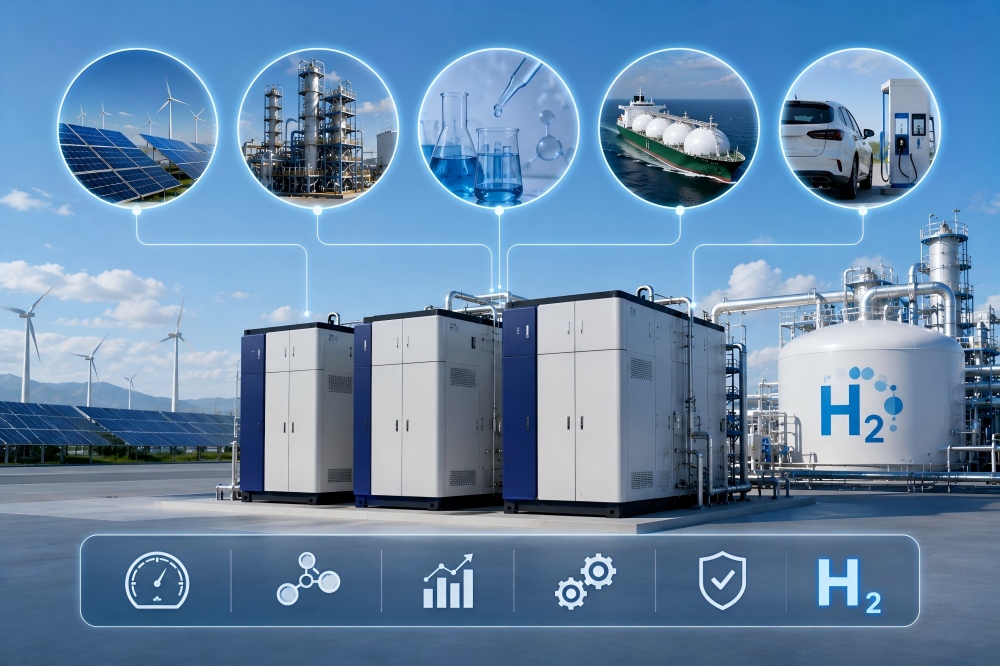
Choosing an industrial hydrogen generator is not simple. You face three technologies, dozens of sizes, and conflicting advice from suppliers. But the right choice depends on just four factors: your hydrogen volume, your purity requirement, your energy cost, and your space.
This guide helps you match an industrial hydrogen generator to your specific application. You will learn which technology works best for metal processing, glass manufacturing, chemical plants, electronics, and hydrogen refueling stations.
For a complete overview of our industrial hydrogen generators, visit: Hydrogen Generator Solutions
The Four Questions Every Industrial Hydrogen Generator Selection Must Answer
Before you look at any equipment, answer these four questions.
1. How much hydrogen do you need per hour? (Nm³/h)
2. What purity does your process require? (99.9%? 99.999%? 99.9999%?)
3. What do you pay for electricity and what is your methanol price?
4. How much floor space do you have?
Your answers will point you toward methanol reforming, PEM electrolysis, or alkaline electrolysis. Let us walk through each industry.
For a detailed demand profiling method, read our guide: Hydrogen Generator Project: 5-Step Planning Guide
Industrial Hydrogen Generator Selection for Metal Processing
Typical applications: Annealing, sintering, heat treating, powder metal reduction
Common purity requirement: 99.999%
Typical volume range: 30‑500 Nm³/h
Metal processing plants need hydrogen continuously during shifts. They cannot afford sudden stops. Methanol reforming works well here because it runs unattended and recovers quickly from brief interruptions.
Recommended technology: Methanol reformer (YPH or OPH series)
Why not PEM? Electricity cost is usually too high. Most metal plants do not have dedicated renewable power.
Why not alkaline? Slow startup and larger footprint.
Example: A stainless steel tube mill installed two YPH‑100 units producing 200 Nm³/h total. They replaced cylinder hydrogen and saved $280,000 in the first year.
Industrial Hydrogen Generator Selection for Glass Manufacturing
Typical applications: Float glass protective atmosphere, glass coating
Common purity requirement: 99.999%
Typical volume range: 100‑1,000 Nm³/h
Glass lines run 24/7 for years. Reliability is everything. Methanol reformers deliver 99.999% hydrogen continuously with minimal maintenance. The waste heat from the reformer can also preheat furnace air – a bonus most buyers overlook.
Recommended technology: Methanol reformer (YPH or OPH series)
Special consideration: Install a dual‑head reformer with automatic switchover. When one side needs catalyst replacement, the other keeps running. Zero downtime.
Industrial Hydrogen Generator Selection for Chemical Plants
Typical applications: Hydrogenation, catalyst regeneration, chemical synthesis
Common purity requirement: 99.9% to 99.999%
Typical volume range: 500‑5,000 Nm³/h
Chemical plants often have existing hydrogen pipelines from steam methane reformers. But when they need extra capacity or want to reduce carbon footprint, a dedicated industrial hydrogen generator makes sense.
Recommended technology: Methanol reformer for volumes under 5,000 Nm³/h. For larger volumes, alkaline electrolysis may be cheaper if electricity is below $0.05/kWh.
Why methanol wins for medium scale: Lower capital cost, faster installation, and the CO₂ byproduct can be used elsewhere in the chemical process.
Example: A specialty chemical plant installed an OPH‑500 methanol reformer to supplement their SMR during peak demand. Payback: 14 months.
For a technology comparison specific to chemical plants, read: SMR vs Methanol Reformer vs Electrolysis
Industrial Hydrogen Generator Selection for Electronics and Semiconductors
Typical applications: CVD carrier gas, annealing atmosphere, reduction gas
Common purity requirement: 99.9999% (6N) or higher
Typical volume range: 5‑100 Nm³/h
Electronics fabs cannot tolerate impurities. A single contamination event can ruin an entire batch of chips. That is why they pay premium prices for ultra‑high purity hydrogen.
Recommended technology: Methanol reformer with metal membrane purification (CPH series)
Why not PEM? PEM also delivers high purity, but the CPH methanol reformer gives even lower hydrocarbon impurities. The metal membrane (palladium alloy) selectively passes only hydrogen, blocking everything else.
Why not alkaline? Purity is too low.
Special consideration: Install the generator in a cleanroom‑adjacent enclosure. Use electropolished stainless steel piping and ultra‑high purity valves.
For CPH series specifications, visit: Ultra‑High Purity Hydrogen Generator
Industrial Hydrogen Generator Selection for Hydrogen Refueling Stations
Typical applications: Fuel cell cars, buses, trucks, forklifts
Common purity requirement: 99.999% (ISO 14687)
Typical volume range: 50‑500 Nm³/h
Refueling stations have variable demand – busy in the morning and evening, quiet overnight. The industrial hydrogen generator must start and stop quickly without wasting energy.
Recommended technology: PEM electrolysis for stations with cheap renewable power. Methanol reformer for stations without.
Why two answers? If you have solar panels or wind, PEM captures every kilowatt hour. If you buy grid power, methanol reforming gives lower operating cost because electricity is expensive.
Example: A California hydrogen station installed a 250 Nm³/h PEM electrolyzer paired with a 1 MW solar array. The station produces hydrogen at $3.50/kg – below the state average.
Industrial Hydrogen Generator Selection: Decision Matrix
Use this table to find your starting point.
| Industry | Typical volume | Purity need | First choice | Second choice |
|---|---|---|---|---|
| Metal processing | 30‑500 Nm³/h | 99.999% | Methanol reformer | – |
| Glass manufacturing | 100‑1,000 Nm³/h | 99.999% | Methanol reformer | – |
| Chemical plants | 500‑5,000 Nm³/h | 99.9‑99.999% | Methanol reformer | Alkaline (if power cheap) |
| Electronics | 5‑100 Nm³/h | 99.9999%+ | Methanol reformer + membrane | PEM (backup) |
| Hydrogen station (renewable power) | 50‑500 Nm³/h | 99.999% | PEM electrolysis | Methanol reformer |
| Hydrogen station (grid power) | 50‑500 Nm³/h | 99.999% | Methanol reformer | – |
For a custom recommendation, contact our engineering team with your volume and utility rates.
Five Signs You Need a Methanol Reformer
Over 70% of our industrial customers choose methanol reforming. Here is why.
1. Your electricity cost exceeds $0.07/kWh. Methanol reformer electricity consumption is negligible. PEM electrolysis would cost 3‑4 times more to run.
2. You want to sell CO₂. A methanol reformer produces concentrated CO₂ (over 95% purity). Capture it, purify it to 5N, and sell it to beverage or welding customers. Revenue can offset 20‑30% of your methanol cost.
3. You have limited space. A 200 Nm³/h methanol reformer fits in a 20‑foot container. PEM or alkaline would need 2‑3 times the footprint.
4. You need fast startup. Methanol reformers reach full production in 15‑30 minutes from cold. PEM is faster (seconds), but alkaline takes hours.
5. You want unattended operation. Our methanol reformers run automatically, with remote monitoring and alerting. No dedicated operator needed.
Common Questions About Industrial Hydrogen Generator Selection
Q: Can one industrial hydrogen generator serve multiple applications?
Yes. Most industrial hydrogen generators connect to a common hydrogen header. Different processes draw what they need. Just size the generator for total peak demand.
Q: How much floor space do I need for an industrial hydrogen generator?
A 100 Nm³/h methanol reformer plus methanol tank and CO₂ storage needs about 70 m² outdoors. All on a concrete pad. No building required.
Q: Do I need a backup generator?
For critical processes (e.g., glass lines that cannot stop), install two generators sized for 60% of peak each. If one fails, the other carries 100% temporarily.
Q: How long does an industrial hydrogen generator last?
15‑20 years. Catalysts in methanol reformers need replacement every 24,000 hours. PEM stacks last 40,000‑60,000 hours.
Q: What is the typical delivery time for an industrial hydrogen generator?
12‑16 weeks for standard skid‑mounted units. Add 2‑4 weeks for site preparation and installation.
Q: How do I choose between 99.999% and 99.9999% purity?
99.999% (5N) works for metals, glass, chemicals, and refueling. 99.9999% (6N) is only for electronics and some research labs. Do not pay for 6N unless you absolutely need it.
Ready to Select Your Industrial Hydrogen Generator?
Choosing the right industrial hydrogen generator does not have to be complicated. Answer the four questions. Use the decision matrix. Then talk to a supplier who understands your industry.
Our team has helped metal plants, glass factories, chemical sites, and hydrogen stations across 30 countries. We can help you, too.
Contact us with your volume, purity, and utility rates. We will send you a technology recommendation and a budget quote within one week.
Explore more industrial hydrogen resources: Hydrogen Generator Project Planning | Hydrogen Generator Safety Checklist