
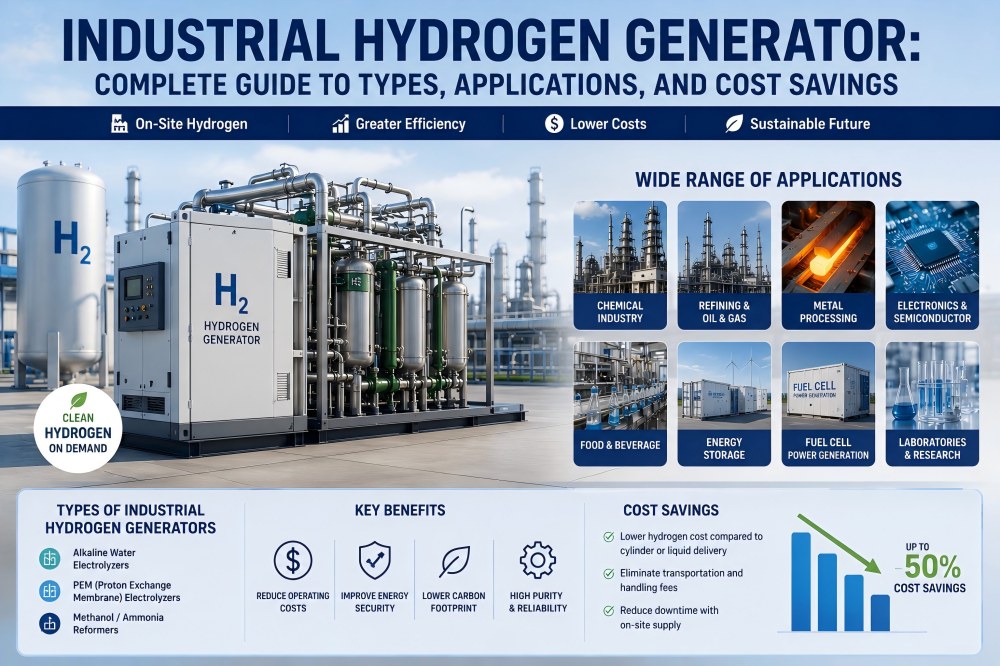
As industries around the world seek cleaner and more cost-effective energy solutions, the industrial hydrogen generator has emerged as a game-changer. Whether you run a metal processing plant, a glass manufacturing facility, or a chemical production site, generating hydrogen on-site can dramatically cut your operating costs and eliminate supply chain headaches.
This guide covers everything you need to know about industrial hydrogen generators—how they work, the different types available, their advantages and disadvantages, and how to choose the right one for your facility.
For a complete overview of our industrial hydrogen solutions, visit: Hydrogen Generators
What Is an Industrial Hydrogen Generator?
An industrial hydrogen generator is a system that converts raw materials—typically methanol, water, or natural gas—into high-purity hydrogen gas on demand. Unlike delivered hydrogen, which arrives in cylinders or tube trailers, an on-site generator produces hydrogen continuously right where you need it.
Modern industrial hydrogen generators can achieve purity levels up to 99.999% (5N) or even 99.9999% (6N), making them suitable for everything from metal heat-treating to semiconductor manufacturing. They are fully automated, require minimal operator attention, and can run 24/7 with proper maintenance.
How Does an Industrial Hydrogen Generator Work?
Industrial hydrogen generators use two main technologies: water electrolysis and methanol reforming.
Water Electrolysis
Water electrolysis uses electricity to split water (H₂O) into hydrogen and oxygen. The reaction is simple:
2H₂O → 2H₂ + O₂
Electrolysis-based industrial hydrogen generators produce ultra-high purity hydrogen with zero CO₂ emissions when powered by renewable energy. PEM (proton exchange membrane) electrolyzers are the most common type today, offering fast response times and compact footprints.
Methanol Reforming
Methanol reforming reacts methanol with water over a catalyst to produce hydrogen and CO₂. The raw syngas then passes through a Pressure Swing Adsorption (PSA) purification unit, which isolates hydrogen to the specified purity.
Methanol-based industrial hydrogen generators offer several advantages:
- Very low electricity consumption—only for pumps and controls
- Compact footprint—fits in a container-sized skid
- Fast startup—minutes from cold to full output
- Built-in CO₂ capture potential for additional revenue
Types of Industrial Hydrogen Generators
Methanol Reformer (Recommended for Most Industrial Sites)
A methanol-based industrial hydrogen generator delivers the lowest total cost of ownership for typical factory volumes of 500–20,000 Nm³/h.
Key advantages:
- Moderate capital cost: $8–12 million for a 10,000 Nm³/h system
- Compact footprint: fits in 100–300 m²
- Quick startup: minutes from cold to full output
- Unattended operation with remote monitoring
- Integrated CO₂ capture adds a second revenue stream
Best for: Metal processing, glass manufacturing, chemical plants, hydrogen refueling stations (grid power)
PEM Electrolyzer
A PEM industrial hydrogen generator produces ultra-high purity hydrogen (99.999%+) and responds to load changes in seconds. It works well when paired with solar or wind power.
Key advantages:
- Ultra-high purity output
- Fast dynamic response
- Zero CO₂ emissions (with renewable power)
Best for: Hydrogen refueling stations (renewable power), electronics, laboratories
Alkaline Electrolyzer
An alkaline industrial hydrogen generator offers the lowest capital cost per kW and the longest operating life. It makes sense for very large facilities with stable grid power.
Key advantages:
- Lowest capital cost per kW
- Longest operating life (80,000+ hours)
- Proven technology
Best for: Very large industrial facilities (>20,000 Nm³/h), stable grid power
Industrial Hydrogen Generator Advantages
Switching to an on-site industrial hydrogen generator delivers several clear benefits.
Lower Operating Cost
On-site hydrogen production eliminates delivery fees, cylinder rental, and supplier markups. A methanol-based industrial hydrogen generator typically delivers hydrogen at 40–60% of the cost of delivered gas.
Reliable Supply
A delayed hydrogen delivery can shut down your entire production line. An on-site industrial hydrogen generator runs continuously as long as you supply feedstock. Your process stays online, and you remain in control.
Consistent Purity
External hydrogen suppliers may change gas sources, causing purity variations between batches. Your own industrial hydrogen generator delivers the same purity hour after hour.
Price Certainty
Delivered hydrogen costs fluctuate with energy markets, logistics rates, and supplier contracts. On-site generation lets you lock in your primary feedstock cost.
Reduced Carbon Footprint
When using green methanol or renewable power, an industrial hydrogen generator offers a low-carbon pathway to hydrogen production.
Industrial Hydrogen Generator Disadvantages
It is not the right fit for every facility. Consider these drawbacks before you invest.
High Initial Investment
The upfront capital cost ranges from $150,000 for a small methanol reformer to over $500,000 for a PEM electrolysis system.
Feedstock Availability
Electrolysis needs a reliable supply of deionized water and significant electricity. Methanol reformers need a steady source of high-purity methanol (sulphur and chlorine below 0.5 ppm).
Periodic Replacement Costs
Methanol reforming catalysts last about 24,000 hours (three years) before needing replacement. PEM stacks last 40,000–60,000 hours. These replacements add to your long-term operating expenses.
Space Requirements
A hydrogen production system needs outdoor space on a concrete pad. A 100 Nm³/h methanol reformer plus methanol tank and CO₂ storage requires about 70 m².
Industrial Hydrogen Generator Applications
Different industries rely on industrial hydrogen generators for specific processes.
Metal Processing (Annealing, Sintering, Heat Treating)
Metal plants need continuous, reliable hydrogen at 99.999% purity. Methanol-based industrial hydrogen generators work best here because they run unattended and recover quickly from interruptions.
Glass Manufacturing (Float Glass Protective Atmosphere)
Glass lines run 24/7 for years. Methanol-based industrial hydrogen generators deliver consistent 99.999% purity with minimal maintenance.
Chemical Plants (Hydrogenation, Catalyst Regeneration)
Chemical plants often need additional hydrogen capacity beyond their existing steam methane reformers. A dedicated industrial hydrogen generator can supplement supply.
Electronics and Semiconductors (CVD Carrier Gas, Annealing)
Electronics fabs require ultra-high purity hydrogen (99.9999%+). Methanol reforming with metal membrane purification delivers the required purity.
Hydrogen Refueling Stations
Refueling stations have variable demand. PEM electrolysis works best with cheap renewable power. Methanol reforming offers lower operating costs for stations using grid power.
Industrial Hydrogen Generator Cost Comparison
How does an on-site industrial hydrogen generator compare to delivered hydrogen?
A 500 Nm³/h industrial hydrogen generator running 8,000 hours per year can save over $2 million annually compared to delivered hydrogen. Payback periods typically range from 2 to 6 months.
How to Choose the Right Industrial Hydrogen Generator
Consider these factors when selecting an industrial hydrogen generator:
- Hydrogen demand (Nm³/h) – Size for peak hourly demand, not average
- Purity requirement – 99.9% for most industrial; 99.999%+ for sensitive applications
- Energy costs – Methanol reforming wins when electricity is above $0.07/kWh
- Space available – Methanol reformers need less footprint than electrolysis
- CO₂ capture potential – Methanol reformers can generate additional revenue from CO₂ sales
Common Questions About Industrial Hydrogen Generators
Q: How long does an industrial hydrogen generator last?
15–20 years with regular maintenance. Methanol reforming catalysts need replacement every 24,000 hours. PEM stacks last 40,000–60,000 hours.
Q: Do I need a dedicated operator?
No. Modern industrial hydrogen generators run unattended. They start and stop automatically based on demand and send alerts when service is due.
Q: What is the typical payback period?
For a methanol reformer replacing delivered hydrogen, payback typically ranges from 6 to 18 months depending on your local hydrogen price and volume.
Q: Can I add CO₂ capture to a methanol reformer?
Yes. The CO₂ capture module bolts on to existing methanol reformers. Many customers add it later when carbon pricing makes capture economic.
Q: What safety certifications should I look for?
Look for ATEX or IECEx for electrical components, PED for pressure vessels, and ISO 22734 for the complete hydrogen generator.
Ready to Choose Your Industrial Hydrogen Generator?
Choosing the right industrial hydrogen generator does not have to be complicated. Answer four questions—volume, purity, energy cost, space—then use the decision framework above to find your starting point.
Our team has helped metal plants, glass factories, chemical sites, and hydrogen stations across 30 countries select and install the right system.
Contact us with your volume, purity requirement, and utility rates. We will send you a technology recommendation and a budget quote within one week.