
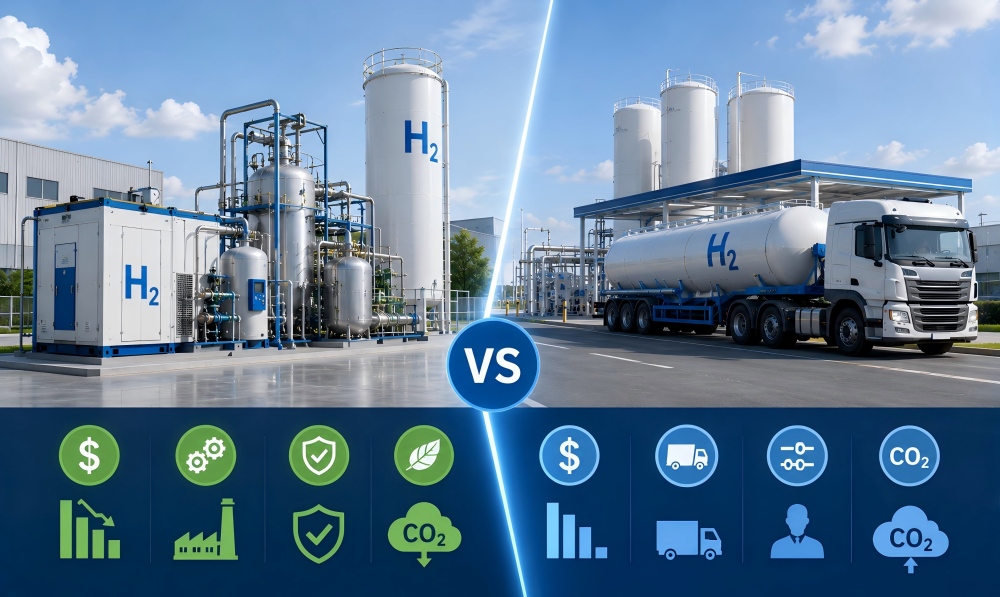
If your facility consumes around 500 normal cubic meters of hydrogen per hour, you face a critical decision. Do you keep buying delivered hydrogen in cylinders or tube trailers? Or do you invest in an on‑site hydrogen generator?
This comparison focuses squarely on the 500 Nm³/h use case—a typical industrial demand level for metal processing, glass manufacturing, chemical plants, and hydrogen refueling stations. You will learn exactly how delivered hydrogen costs break down, what an on‑site methanol reformer costs to run, and how quickly the investment pays back.
For a complete overview of our industrial hydrogen solutions, visit: Hydrogen Generators
Why the 500 Nm³/h Scale Deserves a Close Look
A 500 Nm³/h hydrogen requirement sits at a sweet spot. Below this level, the capital cost of on‑site generation can be harder to justify against small‑cylinder deliveries. Above this level, economies of scale make on‑site generation almost always the winner. At 500 Nm³/h, the decision depends on your local methanol price, electricity cost, and delivered hydrogen rate—but the math increasingly favors on‑site production.
Many industrial hydrogen generators based on methanol reforming are specifically designed for capacities from 15 Nm³/h up to 500 Nm³/h, producing high‑purity hydrogen (99.999%) efficiently and cost‑effectively. That means the 500 Nm³/h mark is well within the proven operating range of mature, off‑the‑shelf technology.
How We Compare: Methodology and Key Assumptions
We use five assumptions that reflect real‑world industrial conditions in 2025‑2026:
- Annual operation: 8,000 hours per year (close to continuous industrial production)
- Methanol price: $400 per metric ton (bulk industrial grade, low‑sulphur, low‑chlorine)
- Electricity price: $0.10 per kWh (realistic for grid‑connected industrial users without dedicated renewables)
- Delivered hydrogen price: $0.80 per Nm³ (mid‑range for cylinder/tube trailer supply in major industrial regions)
- System life: 15 years for on‑site equipment; 10‑year amortization for CAPEX calculation
Your actual numbers may differ. The article later shows you how to adjust each variable and offers a free custom ROI model.
What Is the True Cost of Delivered Hydrogen for 500 Nm³/h?
Delivered hydrogen looks simple. You call a supplier. They send a truck. You get gas. But the price you pay hides several layers of cost.
Most buyers focus on the quoted price per kilogram or per Nm³. In 2025, grey hydrogen from steam methane reforming (SMR) averages $1–3 per kg ($0.07–0.22 per Nm³). Green hydrogen delivered via truck can cost $4–12 per kg ($0.30–0.90 per Nm³), with EU averages in the $5–8 per kg range and some markets seeing delivered prices of $6–9 per kg.
But the quoted price is only part of the story. Delivered hydrogen comes with built‑in overhead: transportation, compression, handling, and storage. These costs can account for 40–60% of the total hydrogen price, and they fluctuate based on distance, logistics, and market conditions.
Annual Delivered Hydrogen Cost for 500 Nm³/h
| Cost Component | Calculation | Annual Cost |
|---|---|---|
| Hydrogen at $0.80/Nm³ | 500 Nm³/h × 8,000 h × $0.80 | $3,200,000 |
| Cylinder rental and handling | $0.10/Nm³ (industry average) | $400,000 |
| Delivery surcharges and logistics | $0.05/Nm³ (distance‑dependent) | $200,000 |
| Administrative and contract fees | Fixed $50,000/year | $50,000 |
| Total annual delivered cost | — | $3,850,000 |
That is nearly $4 million per year for a single 500 Nm³/h consumer. And that cost keeps rising. Green hydrogen costs have increased 25–40% since 2022 due to inflation, supply chain shortages, and higher interest rates. Electricity accounts for 50–60% of electrolysis production costs, meaning any renewable power price surge directly hits delivered green hydrogen prices.
How Much Does an On‑Site Hydrogen Generator Cost to Run for 500 Nm³/h?
A methanol‑based on‑site hydrogen generator turns two inputs—methanol and water—into high‑purity hydrogen at 99.999%. The capital expenditure for a 500 Nm³/h system runs approximately $500,000–700,000 fully installed, including the reformer, PSA purification, water treatment, and a small buffer tank.
The operating costs break down into four main components.
Annual On‑Site Hydrogen Cost for 500 Nm³/h
| Cost Component | Calculation | Annual Cost |
|---|---|---|
| Methanol feedstock | 500 Nm³/h × 0.55 kg/Nm³ = 275 kg/h × 8,000 h = 2,200,000 kg. At $400/ton ($0.40/kg) | $880,000 |
| Electricity | 25 kW average × 8,000 h × $0.10/kWh | $20,000 |
| Water and consumables | Deionized water, catalyst replacement, filters | $60,000 |
| Maintenance (2‑3% of CAPEX) | 2.5% × $600,000 | $15,000 |
| Total annual operating cost | — | $975,000 |
| Annualised CAPEX (10 years) | $600,000 ÷ 10 | $60,000 |
| Total annual on‑site cost | — | $1,035,000 |
Investment Payback: The Bottom Line
| Metric | Value |
|---|---|
| Annual delivered hydrogen cost | $3,850,000 |
| Annual on‑site hydrogen cost | $1,035,000 |
| Annual saving | $2,815,000 |
| CAPEX | $600,000 |
| Simple payback period | 2.6 months |
Even if your delivered hydrogen price is lower ($0.60/Nm³ instead of $0.80/Nm³), the payback period barely changes: total delivered cost drops to around $3.1 million, saving roughly $2 million per year, giving a payback of roughly 3.6 months. Even at the low end of grey hydrogen pricing ($0.22/Nm³), delivered hydrogen still costs roughly $880,000 per year in raw gas alone—before adding transport, cylinders, and logistics. On‑site generation is competitive in virtually any scenario above 200 Nm³/h.
Beyond Dollars: Supply Security, Purity, and Hidden Advantages
Switching from delivered to on‑site hydrogen delivers three non‑financial benefits.
Supply Security
With delivered hydrogen, your operation relies on a truck that might show up late—or not at all. Bad weather, driver shortages, or scheduling conflicts can leave you waiting for days. An on‑site generator produces hydrogen continuously, right where you need it. No deliveries. No scheduling. Uninterrupted 24/7 supply.
Consistent Purity
During transport and transfer, delivered hydrogen can pick up trace contaminants or moisture. A methanol reformer with PSA purification delivers 99.999% hydrogen directly to your process line with minimal handling. That consistency matters enormously in sensitive applications like heat‑treatment furnaces or hydrogenation reactors.
Price Certainty
Delivered hydrogen costs fluctuate with energy markets, logistics rates, and supplier contracts. On‑site generation lets you lock in your primary feedstock cost at the methanol price. You pay for what matters—the gas itself and the modest power to make it—not for transportation, compression, handling, and storage overhead that can account for 40–60% of the total hydrogen price.
CO₂ Capture as a Revenue Stream
A methanol‑based hydrogen generator produces concentrated CO₂ as a byproduct. Capture it, purify it to 5N grade, and sell it to beverage manufacturers, welding suppliers, or food processors. At current market prices of $150–400 per ton, a 500 Nm³/h unit producing roughly 2,000 tons of CO₂ per year could generate $300,000–800,000 in additional annual revenue—further improving the payback picture.
Real‑World Examples of On‑Site Hydrogen Payback
One industrial gas distributor in Southeast Asia installed two methanol reformers replacing delivered hydrogen, achieving a margin increase from 12% to 62% and paying back the equipment investment in less than five months. A glass manufacturer in Europe switched from tube trailer hydrogen to a methanol reformer and saw their hydrogen cost drop by over 50% within the first year. A chemical plant in China added an on‑site generator as a swing unit to supplement their SMR during peak demand, recovering the full investment within 14 months.
Adjusting the Numbers for Your Location
Not every facility has the same methanol or electricity price. Use the formula below to run your own quick calculation:
*Annual saving = (Delivered H₂ price per Nm³ – On‑site cost per Nm³) × 500 × 8,000*
Where on‑site cost per Nm³ roughly equals *(methanol kg/h × price/kg + electricity cost/h + water/maintenance/h) ÷ 500*.
For a methanol price of $400/ton, on‑site hydrogen costs approximately $0.22 per Nm³ for feedstock plus $0.02–0.03 for utilities, consumables, and maintenance—roughly $0.24–0.25 per Nm³. Add annualised CAPEX of roughly $60,000 for a $600,000 system and the fully loaded on‑site cost sits around $0.29 per Nm³.
If your delivered price is lower, plug in your actual numbers. If methanol costs more in your region, adjust accordingly. The breakeven point for a 500 Nm³/h facility typically falls between delivered hydrogen prices of $0.40 and $0.50 per Nm³. Most industrial users pay well above that.
For a custom ROI projection tailored to your site, contact us for a free feasibility analysis.
FAQ
Q: What is the typical payback period for a 500 Nm³/h methanol reformer?
For a facility paying $0.80 per Nm³ for delivered hydrogen, payback typically ranges from 2 to 6 months. Even with very low delivered hydrogen prices ($0.40–0.50 per Nm³), payback remains under 2 years.
Q: Does a methanol reformer need a dedicated operator?
No. Modern systems run unattended. They start and stop automatically based on demand and send alerts when service is due.
Q: What purity does a methanol reformer deliver?
99.999% (5N) hydrogen as standard, using PSA purification. This exceeds the requirements for most industrial processes, including metal heat‑treating and glass manufacturing.
Q: How much floor space does a 500 Nm³/h system require?
Roughly 100–150 m² for the generator and a methanol tank. All equipment sits outdoors on a concrete pad.
Q: How long does a methanol reformer last?
15–20 years with regular maintenance. The catalyst needs replacement every 24,000 hours (about three years of continuous operation). Catalyst replacement costs are modest—typically $15,000–25,000 per change, which we included in the water and consumables line above.
Q: What if my delivered hydrogen price is much lower than $0.80/Nm³?
Even at $0.40–0.50 per Nm³, the payback period for a 500 Nm³/h system remains under two years. At those prices, however, you should verify the purity and supply consistency you are actually receiving—low‑cost delivered hydrogen often comes with lower quality or less reliable logistics.
Q: Can I start with a smaller on‑site generator and scale up later?
Yes. Modular methanol reformers allow you to install 250 Nm³/h units and add a second unit when demand grows. This preserves capital while you validate the business case.
Q: What safety certifications does an on‑site hydrogen generator need?
Look for ATEX or IECEx for electrical components, PED for pressure vessels, and ISO 22734 for the complete hydrogen generator. Our systems carry all three.
Q: Do you offer financing or leasing options for the equipment?
Yes. We work with financing partners to offer leasing and hydrogen‑as‑a‑service models. Contact us for options that require zero upfront capital.
Ready to Calculate Your Own Numbers?
Every facility has unique hydrogen demand patterns, local methanol prices, and delivered hydrogen rates. Our engineering team can prepare a custom feasibility study for your 500 Nm³/h application, comparing your current delivered costs against an on‑site methanol reformer with real numbers.
Contact us today with your current hydrogen price and annual volume. We will send you a detailed ROI projection within one week.