
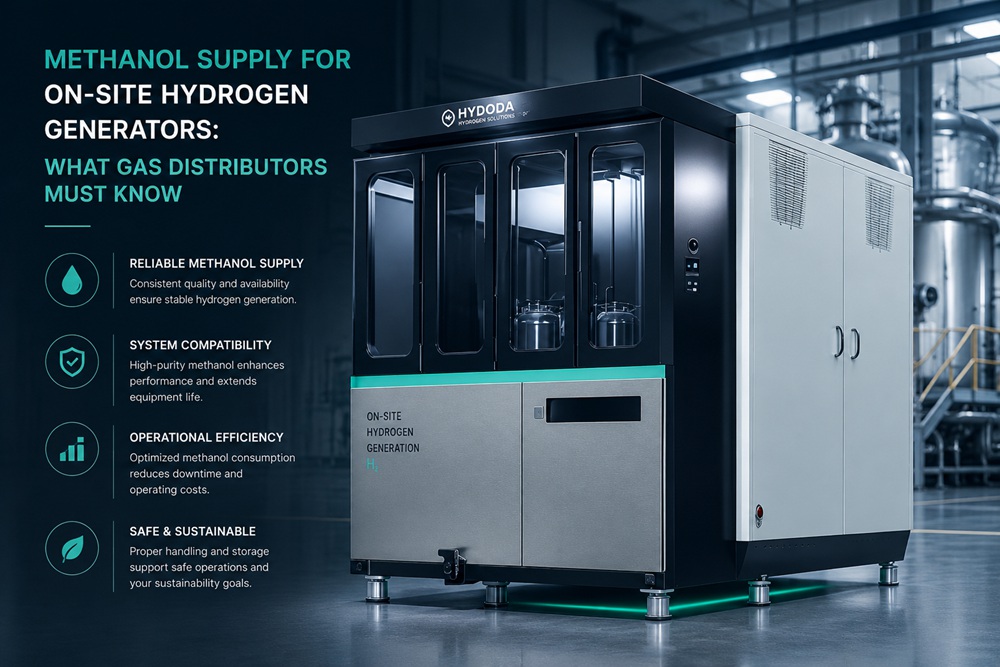
You already sell industrial gases. Now you are looking at on‑site hydrogen generators as a new service for your customers. Good move. But here is something you might not have thought through yet: where does the methanol come from?
Most people focus on the generator itself. They forget that a methanol‑based hydrogen generator needs a steady, reliable supply of methanol. And that is where you, as a gas distributor, have a real opportunity.
This article covers what we have learned about supplying methanol for on‑site hydrogen generators. You will find practical tips on tank sizing, safety, quality, and how to keep your customers happy without making extra work for yourself.
First, How Much Methanol Are We Talking About?
Let us get a feel for the numbers.
A typical methanol‑based hydrogen generator uses roughly 0.55 kg of methanol for every normal cubic meter of hydrogen it produces. That does not sound like much. But multiply it out.
Say a customer runs a 100 Nm³/h generator for 8,000 hours a year. That is 440 metric tons of methanol annually. Not a tiny amount. For you, that means a predictable, recurring volume. For your customer, it means a steady operating cost.
When you help a customer pick a generator, you can estimate their methanol needs. Just ask their expected daily hydrogen usage. Multiply by 0.55. That is kilograms of methanol per hour.
Sizing a Methanol Tank: Keep It Simple
You do not need to overthink tank sizing. Here is the rule we use.
First, figure out how many days you want between deliveries. One week? Two weeks? A month? Most gas distributors we work with start with two‑week cycles.
Take the customer’s daily methanol consumption. Multiply by the number of days. Then add a 30% safety cushion. That is your tank size.
Example: daily consumption 1,000 kg. Two‑week cycle = 14 days × 1,000 kg = 14,000 kg. Add 30% = 18,200 kg. Methanol weighs about 0.79 kg per liter, so that translates to roughly 23,000 liters.
A 25,000‑liter tank works fine. You can go bigger if the customer has space and wants fewer deliveries. But do not go smaller than the two‑week buffer unless you have a very reliable delivery schedule.
What Kind of Tank Should You Use?
Most of our customers use above‑ground, double‑walled carbon steel tanks. Double‑walled gives you leak containment built right in. That simplifies environmental compliance.
Single‑walled with a concrete dike also works. But double‑walled is cleaner and takes less space.
You will need a few basic accessories:
- A vent with a flame arrester
- A pressure relief valve
- A level gauge (preferably with remote monitoring)
- A grounding point for tanker trucks
- A spill containment around the fill connection
Do not skip the level monitoring. You cannot afford a dry tank. A customer who runs out of methanol stops producing hydrogen. That is a bad day for everyone. Remote level sensors cost a few hundred dollars and save you from emergency deliveries and angry phone calls.
Which Methanol Grade Should You Buy?
Here is something many people get wrong. They think any industrial methanol works. Not quite.
The methanol you supply for a methanol‑based hydrogen generator needs to be low in sulfur and chlorine. Those two impurities poison the copper catalyst inside the reformer. Once the catalyst is poisoned, it loses activity. The generator works harder, uses more methanol, and eventually stops making enough hydrogen.
Ask your methanol supplier for a certificate of analysis. Look for:
- Sulfur below 0.5 ppm
- Chlorine below 0.5 ppm
- Purity above 99.85%
If your supplier cannot provide those numbers, find another supplier. A few extra cents per liter is worth it if it doubles the catalyst life.
Our own catalyst, by the way, lasts over 24,000 hours when you feed it clean methanol. That is about three years of continuous running. Dirty methanol cuts that life in half.
Safety and Regulations: What You Actually Need to Do
Methanol is flammable. It has a flash point around 11°C. That means at room temperature, it can give off enough vapor to ignite.
But do not panic. Methanol is not uniquely dangerous. It is similar to handling gasoline or ethanol. You just need to follow the rules for Class I flammable liquids.
What does that mean in practice?
- Keep the tank away from open flames and spark‑producing equipment.
- Put up “No Smoking” signs.
- Install a spill containment basin or use a double‑walled tank.
- Bond and ground the tank during truck filling.
- Have a fire extinguisher nearby.
You will also need a permit from your local fire department or building department. Every jurisdiction is different. Allow a few weeks for plan review.
One tip: involve the local fire marshal early. Invite them to see your planned installation. Most are helpful if you show you care about doing things right.
Delivering Methanol: Not Much Different from Diesel
If you already deliver diesel or gasoline, methanol delivery will feel familiar.
Use a dedicated truck or a compartment that has been thoroughly cleaned for methanol. Cross‑contamination with other fuels can ruin the methanol quality.
Install a calibrated flow meter on the truck or at the tank. Your customer pays for what you deliver. Keep delivery records with date, volume, and temperature.
Some regions require vapor recovery systems during filling. Methanol vapors are heavier than air, but the rules vary. Check with your local air quality agency.
Remote Monitoring: A Small Investment That Pays Off Fast
You do not want to discover a customer is out of methanol because they call you in a panic.
Install a simple tank level sensor that sends data to a cloud dashboard. You can check levels from your phone. Set up alerts at 30% and 20%. When the alert comes, you schedule a delivery.
One gas distributor we work with monitors over 40 methanol tanks across three states. They use one part‑time person to manage all deliveries. No emergency calls. No rush orders. Just smooth, predictable logistics.
The sensors cost about 200to500 each. They pay for themselves the first time they prevent an after‑hours delivery.
Keeping Methanol Fresh: Not Really a Problem
Methanol does not go bad quickly. In a sealed tank, it can sit for years. The main enemy is water. Methanol absorbs moisture from the air. Too much water and the generator’s performance drops.
Keep the tank sealed. Check the gaskets on hatches and fill ports. In humid climates, consider adding a desiccant breather.
If a customer stores methanol for more than six months, take a sample. Send it to a lab for water content analysis. If it is above 0.2% water, you might want to replace it.
Honestly, though, most of our customers use methanol fast enough that water absorption is never an issue.
Common Questions Gas Distributors Ask Us
Q: How long does methanol last in storage?
Years, if the tank stays sealed. We have seen methanol stored for five years with no measurable degradation.
Q: Do I need a special permit for a methanol tank?
Yes. Most local codes require a permit for flammable liquid storage over a certain size. Plan on a few weeks for approval.
Q: Can I use a gasoline tank for methanol?
No. Methanol can attack some seal materials and gaskets used in gasoline systems. Use a dedicated methanol tank.
Q: What happens if the generator runs out of methanol?
It stops. Most systems have a safe shutdown routine. But you want to avoid this. Use remote level monitoring.
Q: How much does a methanol storage system cost?
A 25,000‑liter double‑walled tank with basic accessories and installation typically runs 15,000to30,000. Costs vary widely by region and site conditions.
Q: Can you help me design a methanol supply system for a specific customer?
Yes. Contact us with the customer’s hydrogen demand and delivery schedule. We will give you a tank size recommendation and a layout sketch.
Supplying methanol for on‑site hydrogen generators is a straightforward business once you set up the right equipment and habits. You keep your customers running. You earn a steady recurring margin. And you build relationships that last.
Ready to get started? Reach out. We have helped gas distributors in over 30 countries make this work. We can help you too.
Want to see the bigger picture for gas distributors? Read our guide: On‑Site Hydrogen Generators: Grow Your Gas Business.