
When you run a methanol-based hydrogen generator, you focus on hydrogen output. But have you ever wondered what happens to the CO2 your system produces? Most operators vent it. Some pay to dispose of it. But smart operators are starting to ask a different question: what if that CO2 could pay for itself?
At Hyvoda, we built our methanol-to-hydrogen systems with exactly that question in mind. Our integrated carbon capture and utilization (CCU) technology captures the CO2 your process already generates, purifies it to 99.999% (5N) or even 99.9999% (6N) purity, and delivers it as liquid CO2 ready for industrial use . In this post, we’ll walk you through how this works, why it matters for your bottom line, and how you can start turning a waste stream into a new revenue stream.
What Is CO2 Capture and Purification in a Hydrogen Generator?
Let’s start with what your hydrogen generator actually does. Your system uses a catalytic reactor to convert methanol and water into hydrogen-rich syngas. From there, a Pressure Swing Adsorption (PSA) unit separates high-purity hydrogen (up to 99.999%) from the rest of the gas stream . That leftover gas? It’s mostly CO2, along with small amounts of impurities like oxygen, moisture, and residual hydrogen.
In a standard hydrogen generator, this CO2 stream goes to the atmosphere. But in our integrated system, we route it through a complete carbon capture and purification train that turns it into a saleable product .
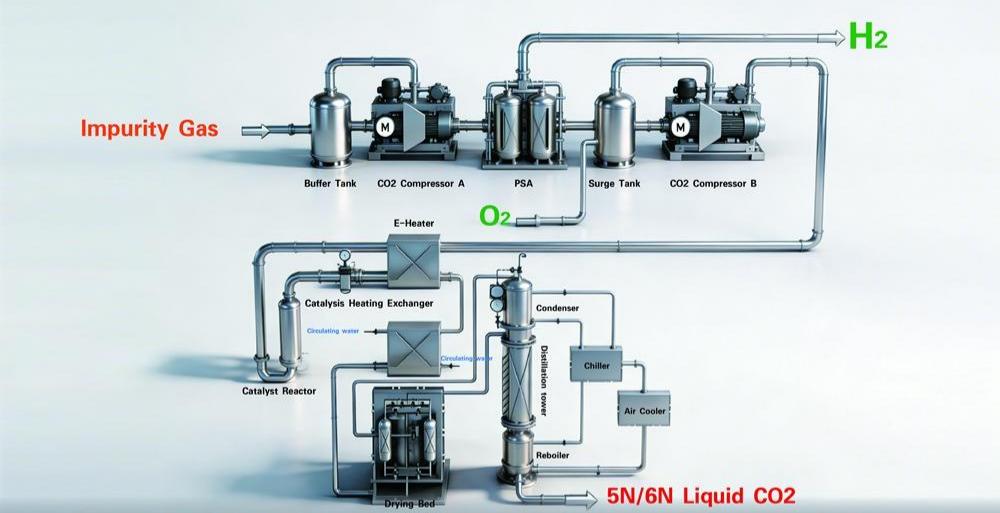
The process follows a clear sequence, based on the flow diagram you’ve seen from our engineering team:
- PSA Separation – The PSA unit sends CO2-rich tail gas to the capture system
- Buffer & Surge Tanks – These stabilize pressure and flow for downstream processing
- Two-Stage Compression – CO2 compressors raise the gas pressure for efficient liquefaction
- Cooling & Condensation – A chiller and condenser cool the gas, triggering phase change to liquid
- Drying Bed – Removes residual moisture to prevent ice formation and ensure purity
- Distillation Column – A reboiler and rectification section separate remaining impurities
- Final Storage – The system delivers 5N or 6N liquid CO2 to insulated storage tanks
The result? Your hydrogen generator now produces two valuable products: hydrogen for your process and high-purity liquid CO2 you can sell or use internally.
Why High-Purity CO2 Matters for Your Business
Not all CO2 is created equal. The purity level determines what you can do with it and how much buyers will pay.
5N (99.999%) CO2 – The Industrial Standard
This purity grade meets the requirements for most commercial applications :
- Food & Beverage – Carbonation, modified atmosphere packaging, dry ice production
- Welding & Metal Fabrication – Shielding gas for arc welding and laser cutting
- Chemical Processing – pH adjustment and feedstock for downstream reactions
6N (99.9999%) CO2 – The High-End Market
When you achieve six-nines purity, you open doors to premium applications :
- Electronics Manufacturing – Supercritical CO2 cleaning for semiconductor wafers
- Laboratory & Analytical – Carrier gas for high-precision instruments
- Specialty Chemical Synthesis – Feedstock requiring ultra-low impurity profiles
The global carbon capture, utilization, and storage (CCUS) market is projected to grow from $7 billion in 2024 to nearly $36 billion by 2032—a compound annual growth rate of 22.6% . Companies that can supply captured CO2 at these purity levels are positioned to capture significant value from this expanding market.
How Our Integrated System Delivers More Value
Adding CO2 capture to your hydrogen generator changes the economics of your operation. Here’s how.
You Eliminate a Waste Disposal Cost
If you currently pay for CO2 disposal or emissions credits, capturing that CO2 removes that cost entirely. In regions with carbon pricing mechanisms or emissions trading systems, this translates directly to savings on your compliance obligations.
You Create a New Revenue Stream
Local CO2 markets exist wherever industries need the gas. By producing 5N or 6N liquid CO2 on-site, you can:
- Sell to local beverage manufacturers, welding suppliers, or cold storage operators
- Supply internal processes that currently purchase CO2 from external vendors
- Qualify for carbon credits by documenting permanent sequestration or utilization
You Reduce Your Energy Bill Through Heat Integration
The purification process includes an electric heater and catalytic heat exchanger that recovers waste heat from the reformer. This heat integration reduces the total energy required for CO2 processing compared to standalone capture systems.
You Gain a Competitive Edge in Procurement
When buyers evaluate hydrogen suppliers, the ability to offer a “carbon-managed” product—where CO2 is captured rather than vented—can differentiate your bid. Major industrial customers increasingly prioritize suppliers with documented decarbonization capabilities.
Common Questions About CO2 Capture from Hydrogen Generators
Q: How much CO2 does my hydrogen generator produce?
For every 100 Nm³ of hydrogen your system generates, you produce approximately 50 kg of CO2. This ratio holds consistently across methanol reforming processes .
Q: What purity can I realistically achieve?
Our systems deliver 5N (99.999%) as standard, with 6N (99.9999%) available for applications requiring ultra-high purity. The PSA tail gas composition determines the baseline, and our distillation column removes residual impurities to meet these specifications .
Q: How does this affect my hydrogen production?
The CO2 capture system operates in parallel with your hydrogen output. Your hydrogen production capacity remains unchanged—we’re simply processing a stream that would otherwise go to atmosphere.
Q: What applications require 6N vs 5N CO2?
Food-grade applications typically accept 5N purity. Electronics manufacturing and semiconductor cleaning require 6N or higher to avoid contamination that could impact yields.
Q: Can I store the liquid CO2 on-site?
Yes. Our system delivers liquid CO2 at conditions compatible with standard insulated storage tanks. We can help you size the storage capacity based on your production volume and usage patterns.
Q: Is the capture system available as a retrofit?
We can integrate CO2 capture with new hydrogen generator installations or retrofit existing systems depending on your current configuration. Contact our engineering team for a site-specific assessment.
Ready to Capture More Value from Your Hydrogen Generator?
When you choose a Hyvoda hydrogen generator with integrated CO2 capture, you’re not just buying equipment—you’re building a more profitable operation. You stop paying to dispose of CO2 and start selling it. You meet tightening emissions standards while generating measurable returns.
Our team can walk you through the numbers for your specific production scale and local market conditions. contact us
Want to learn more about hydrogen generator operating costs? Check out our guide: Hydrogen Generator Power Consumption: What Really Impacts Your Cost.