
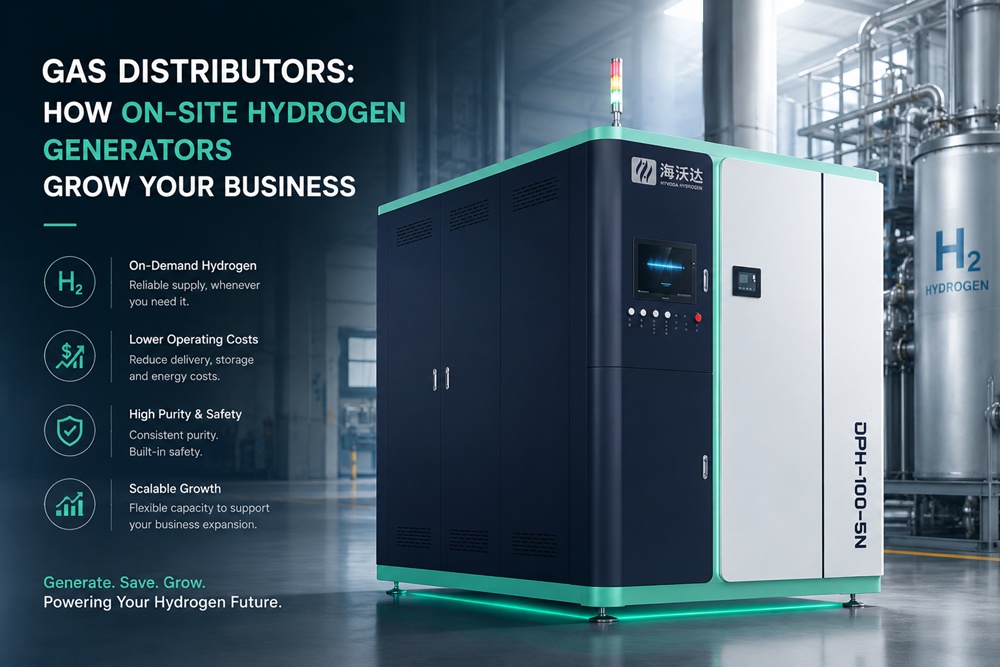
You already sell industrial gases. Your customers buy hydrogen in cylinders or tube trailers. You manage deliveries, handle permits, and chase payments. It works. But margins are tight and competition is fierce.
Now imagine this. Your customer installs a small on-site hydrogen generator at their facility. You supply the methanol. The generator makes hydrogen automatically. Your customer never runs out. And you earn a steady, recurring revenue stream from the methanol you sell.
This is not a distant future. Gas distributors around the world are adding on-site hydrogen generators to their product mix. They are winning new customers, locking in long-term contracts, and growing their businesses. Here is how you can do the same.
Why Gas Distributors Need On-Site Hydrogen Generators Today
The hydrogen market is changing fast. Your customers face three big problems that on-site generation solves.
Problem 1: Hydrogen delivery is expensive and unreliable. Your customers pay for cylinder rental, transport fees, and supplier markups. A late delivery can shut down their production line.
Problem 2: Hydrogen costs are rising. Carbon taxes make grey hydrogen more expensive every year. Your customers want a cheaper, more stable source.
Problem 3: Green hydrogen pressure is real. Large customers now demand hydrogen with a verified carbon footprint. On-site generation using green methanol or renewable power gives you that proof.
An on-site hydrogen generator fixes all three. Your customer gets hydrogen at lower cost. You get a recurring customer locked into your methanol supply. And everyone wins on sustainability.
How Gas Distributors Make Money with On-Site Hydrogen Generators
You have several business models to choose from.
Model 1: Sell the Generator and Keep the Methanol
Your customer buys the on-site hydrogen generator upfront. You install it and train their team. Then you supply methanol on a recurring basis. Your customer pays a fixed price for methanol, and you earn a predictable margin. This model works well for customers who want to own their equipment.
Model 2: Lease the Generator and Charge for Methanol
You own the generator. Your customer pays a monthly lease fee plus the cost of methanol. This model lowers your customer’s upfront investment. You earn more over time because you keep the equipment ownership. Many gas distributors prefer this approach because it creates a longer-term relationship.
Model 3: Build Your Own Hydrogen Production Station
Install a larger on-site hydrogen generator at your own distribution yard. From there, you produce hydrogen and fill your own cylinders or tube trailers. That lets you cut out your upstream hydrogen supplier entirely. The result? You set your own price. And you sell hydrogen to multiple customers from your own production.
Our YPH series, for example, produces 150 to 500 Nm³ per hour of 99.999% pure hydrogen. That is enough to supply dozens of local customers. The system fits in a standard 20‑foot container footprint—about 30 square meters. You can place it right at your yard.
What On-Site Hydrogen Generators Your Gas Customers Actually Need
Your customers have different hydrogen needs. Match the right on-site hydrogen generator to each customer type.
| Customer Type | Typical Demand | Recommended Generator | Why |
|---|---|---|---|
| Small metal shop or lab | 15–100 Nm³/h | DPH series | Compact, low cost, replaces cylinders |
| Medium glass or chemical plant | 150–500 Nm³/h | YPH series | High purity, stable output, low operating cost |
| Large steel mill or refinery | 150–500+ Nm³/h | OPH series | Self-heating technology cuts electricity use by over 80% |
| Electronics or semiconductor fab | 3–15 Nm³/h ultra-high purity | CPH series | 99.999999% purity, metal membrane purification |
All systems operate fully automatically. They start and stop based on demand. They send alerts when maintenance is due. Your customer does not need a dedicated operator.
Why Your Customers Will Love On-Site Hydrogen Generators
Your customers already buy hydrogen from you. But they have pain points you might not see.
They hate cylinder handling. Moving heavy cylinders around a shop floor is dangerous and labor-intensive. An on-site hydrogen generator eliminates cylinders completely. Hydrogen flows through a pipe directly to their process.
They worry about purity. A contaminated cylinder can ruin a whole batch of product. Your generator produces consistent purity every time. Our YPH and OPH series deliver 99.999% purity. The CPH series delivers 99.999999% for the most sensitive applications.
They want lower costs. On-site hydrogen typically costs 30% to 50% less than delivered hydrogen. Your customer saves money. You still earn a healthy margin on methanol supply.
They care about safety. Our on-site hydrogen generators are fully explosion-proof (ATEX/IECEx certified). They include automatic gas detection and shutdown systems. Your customer can sleep better knowing there are no high-pressure cylinders in their facility.
Real Numbers: A Gas Distributor Case Study (Disguised)
One of our gas distributor customers in Southeast Asia used to buy liquid hydrogen from a large supplier. They resold it to local glass and metal customers. Margins were thin—around 12%. Delivery logistics were a constant headache.
They installed two YPH-250 units at their own yard. Each unit produces 250 Nm³ per hour. The total investment was under 500,000.Theynowproducehydrogenat0.22 per Nm³. They sell it for $0.45 per Nm³. Their margin jumped to over 50%. They pay back the equipment in less than two years. And they now control their own supply chain.
Could you do the same? Probably.
What to Look for in an On-Site Hydrogen Generator for Your Business
When you evaluate on-site hydrogen generators, prioritize these features.
Low operating cost. Your business model depends on keeping your own costs low. Look for systems with high thermal efficiency. Our OPH series uses self-heating catalytic oxidation technology. It cuts electrical power consumption by more than 80% compared to traditional electric heating. That is a huge advantage for your bottom line.
Long catalyst life. Catalyst replacement is a major operating expense. Our catalysts last over 24,000 hours—1.5 to 2 times longer than conventional catalysts. That means fewer replacements and lower costs for you.
Small footprint. Space is expensive. Our on-site hydrogen generators are highly integrated. A 100 Nm³/h unit fits in a 20‑foot container. You can install it at your yard or at your customer’s facility without major civil work.
Remote monitoring and automation. You cannot afford to send technicians every time a machine beeps. Our systems run unattended. They send alerts to your phone. You can monitor multiple generators from a single dashboard. Some of our customers manage a dozen units across a region with just one part-time technician.
Certifications. Look for ATEX, IECEx, PED, and ISO 22734. These prove the on-site hydrogen generator is safe and meets international standards. Your customers will ask for them.
How to Start Offering On-Site Hydrogen Generators to Your Customers
Starting is simpler than you think.
Step 1: Identify your best customers. Look for customers who use more than 50 Nm³ of hydrogen per day. Metal treaters, glass plants, and chemical processors are good targets.
Step 2: Run the numbers for them. Calculate their current hydrogen cost including delivery, cylinder rental, and taxes. Then show them the cost with an on-site hydrogen generator using methanol at your bulk price. The savings will speak for themselves.
Step 3: Choose the right equipment. We will help you size the generator based on their peak demand and operating pattern.
Step 4: Offer flexible financing. Some customers will buy the generator outright. Others prefer a lease or hydrogen-as-a-service model where they pay only for the hydrogen they use. You can offer both.
Step 5: Install and start supplying methanol. We provide installation supervision and training. Your customer connects the generator to their process. You start delivering methanol. Everyone wins.
What About CO₂ Capture? Another Revenue Stream for You
Here is a bonus. Every methanol-based on-site hydrogen generator produces CO₂ as a byproduct. You can capture that CO₂, purify it to 5N or 6N grade, and sell it as liquid CO₂.
Your glass customers need CO₂ for laser cutting. The same gas goes to food and beverage customers for carbonation. And for welding customers, it serves as a shielding gas. Instead of buying CO₂ from someone else, you can make your own—right along with the hydrogen.
Our integrated CO₂ capture module recovers over 95% of the CO₂ from the hydrogen production process. It delivers liquid CO₂ at 99.999% or 99.9999% purity. That is a second revenue stream from the same equipment.
Common Questions from Gas Distributors
Q: What is the typical return on investment for a gas distributor buying an on-site hydrogen generator?
Most distributors see payback in 18 to 30 months. The exact timeline depends on your local methanol price, electricity cost, and hydrogen selling price. Contact us for a custom ROI model for your location.
Q: Do I need special permits to install an on-site hydrogen generator?
Yes, but the process is straightforward. Our systems are certified to international standards, which simplifies local approvals. We provide documentation to support your permit applications.
Q: How much methanol does a hydrogen generator use?
A 100 Nm³/h unit consumes about 55 kg of methanol per hour. You can bulk buy methanol just like you already bulk buy other gases. The storage tank is simple and low-cost.
Q: Can I install a hydrogen generator at a customer’s site and still own the equipment?
Absolutely. We have many gas distributor customers who own the generators and place them at customer facilities. You keep the equipment ownership. You sell methanol and service. The customer gets hydrogen without capital investment.
Q: What happens if the generator breaks down?
Our systems achieve 72,000 hours of trouble‑free continuous operation in industrial environments. They are designed for reliability. But if something fails, our remote monitoring alerts us. We can often diagnose and fix issues remotely. For hardware failures, we ship replacement parts within 24 hours.
Q: How much floor space do I need at my own yard for a hydrogen production station?
A 250 Nm³/h YPH unit needs about 30 square meters plus space for a 10‑ton methanol tank and a small CO₂ storage tank. You can fit a complete production station on a standard loading dock.
Ready to Grow Your Gas Distribution Business?
Adding on-site hydrogen generators to your product line changes your business. Stop being a reseller of other people’s gas. Become a producer instead. That means you capture more value and lock in your customers for the long run. And you build a business that grows even when commodity prices fluctuate.
We have helped gas distributors in over 30 countries make this transition. Our team will walk you through the equipment selection, business model, and installation process.
Want to understand the technical side of hydrogen generation? Read our guide: Hydrogen Generator: Complete Buyer’s Guide for Industry.
Interested in safety and compliance? Read: Hydrogen Generator Safety: 7 Critical Checks Before Installation.