
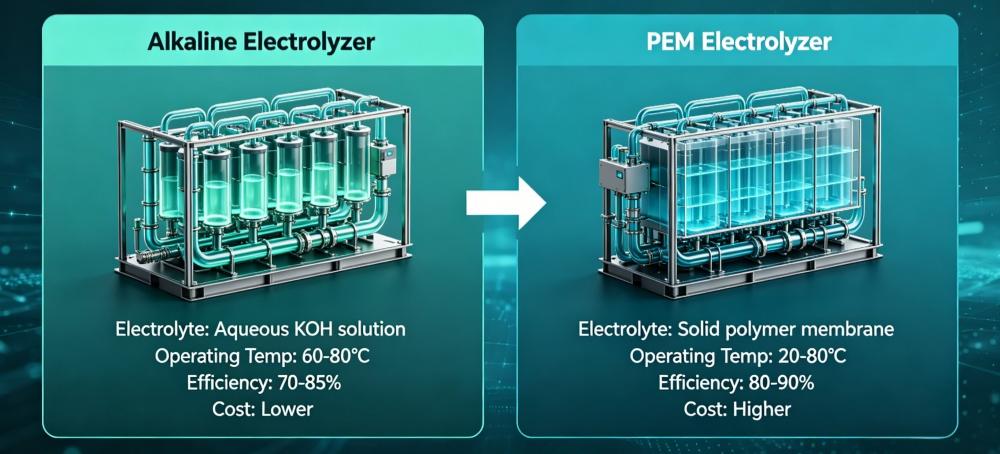
When planning a green hydrogen project, choosing between an alkaline vs PEM electrolyzer is one of the most important investment decisions. Both technologies support clean hydrogen production, but they differ in capital cost, operating efficiency, renewable response, maintenance cycle, and long-term return.
For project developers, EPC contractors, chemical plants, and renewable energy investors, the right alkaline vs PEM electrolyzer for green hydrogen strategy directly affects hydrogen cost per kilogram, expansion flexibility, and project payback period.
At HYVODA, we provide ALK, PEM, AEM, and hybrid ALK + PEM electrolyzer clusters, allowing customers to match the technology to real load conditions rather than forcing a one-size-fits-all approach.
How Alkaline vs PEM Electrolyzer Technologies Differ
Both technologies split water into hydrogen and oxygen, but their operating logic is different.
Alkaline Electrolyzer
An alkaline system uses:
- 30% KOH electrolyte
- composite diaphragm or membrane
- stable continuous DC electrolysis
- excellent long-term baseload performance
It is best for:
- green ammonia
- methanol synthesis
- refinery hydrogen
- steel decarbonization
- large renewable hydrogen hubs
PEM Electrolyzer
A PEM electrolyzer uses:
- proton exchange membrane
- pure water feed
- compact stack structure
- rapid dynamic response
- direct high-pressure hydrogen output
It is ideal for:
- wind-to-hydrogen
- solar hydrogen
- hydrogen refueling stations
- intermittent renewable balancing
- urban hydrogen energy hubs
Green Hydrogen Cost per kg: Alkaline vs PEM Electrolyzer
For industrial buyers, the real question is not just technology.
It is:
Which system gives the lowest hydrogen cost per kg?
Electricity Cost
Under HYVODA actual operating conditions:
HYVODA Alkaline
- 3.9–4.4 kWh/Nm³
- best for stable 24/7 hydrogen demand
HYVODA PEM
- 3.9–4.5 kWh/Nm³
- stronger under renewable fluctuations
When power supply is stable, alkaline vs PEM electrolyzer comparisons usually favor alkaline because lower CAPEX and long baseload runs improve cost per kg.
However, when renewable power changes frequently, PEM reduces curtailment loss and often lowers practical hydrogen cost.
Compression Cost: PEM Has a Direct Pressure Advantage
Compression cost is often ignored in early project planning.
This is where PEM has a strong advantage.
HYVODA PEM systems can provide:
3.5 MPa direct hydrogen pressure
This reduces or partially removes downstream compression requirements.
For applications such as:
- hydrogen refueling
- mobility fuel
- tube trailer filling
- distributed hydrogen stations
this can significantly reduce:
- compressor CAPEX
- energy use
- maintenance frequency
In these scenarios, PEM often creates a better total ROI.
Stack Lifetime and Maintenance Cost Comparison
Long-term maintenance has a major impact on ROI.
HYVODA Alkaline
- 10+ year stack lifetime
- 30-year system design life
- easier large-scale batch maintenance
- lower long-term replacement cost
HYVODA PEM
- 5-year stack lifecycle typical
- faster stack response
- stronger flexibility value
For continuous industrial hydrogen use, alkaline vs PEM electrolyzer economics often favor alkaline due to longer stack life.
Which Is Better for Green Ammonia and Methanol Projects?
This is where alkaline usually wins.
For projects like:
- green ammonia
- synthetic methanol
- hydrogen-based chemicals
- refinery desulfurization
hydrogen demand usually stays stable for long periods.
That means:
low CAPEX + long stack life + stable baseload = better ROI
This is why HYVODA’s Morocco Green Ammonia Project and large Ningdong projects both use alkaline electrolysis.
For chemical synthesis, alkaline remains the preferred large-scale route.
Which Is Better for Solar and Wind Hydrogen Projects?
For renewable fluctuation, PEM usually performs better.
HYVODA PEM supports:
- cold start <5 min
- hot start <30 s
- rapid peak-valley switching
- better renewable power following
- strong grid balancing support
This makes PEM ideal for:
- offshore wind hydrogen
- solar hydrogen farms
- curtailed renewable recovery
- distributed hydrogen mobility
When renewable intermittency is strong, PEM often increases renewable utilization enough to justify higher CAPEX.
Why a Hybrid ALK + PEM Electrolyzer Often Creates the Best ROI
This is where HYVODA has a major engineering advantage.
Many suppliers only compare:
ALK or PEM
HYVODA often designs:
ALK + PEM hybrid electrolyzer clusters
Why This Works Better
- ALK handles baseload hydrogen
- PEM handles renewable fluctuation peaks
- reduces overdesign risk
- improves renewable absorption
- balances CAPEX and flexibility
For GW-scale wind + solar hydrogen hubs, this hybrid design often delivers the best cost-performance balance.
Best Technology Choice by Project Scenario
Opt for Alkaline If You Need
- large continuous hydrogen demand
- green ammonia
- methanol synthesis
- lower CAPEX
- long service life
- easier MW–GW expansion
Choose PEM If You Need
- fast renewable response
- direct high-pressure hydrogen
- hydrogen refueling
- urban compact deployment
- solar and wind peak management
Choose HYVODA Hybrid If You Need
- renewable baseload + fluctuation
- lowest total hydrogen cost
- future-proof expansion
- flexible EPC integration
Why HYVODA Delivers Better Value in Alkaline vs PEM Electrolyzer Projects
HYVODA’s advantage is not only technology supply.
We combine:
- ALK
- PEM
- AEM
- containerized systems
- IoT matrix control
- remote predictive maintenance
- EPC integration
- renewable hydrogen clusters
- global project delivery
This allows customers to optimize:
- cost per kg
- stack lifecycle
- compression CAPEX
- land use
- renewable utilization
- future expansion
Instead of choosing a generic technology, customers get the best-fit hydrogen architecture.
FAQ: Alkaline vs PEM Electrolyzer for Green Hydrogen
1. Which is cheaper for large green hydrogen plants?
Alkaline is usually more cost-effective for stable MW–GW projects.
2. Which is better for wind and solar hydrogen?
PEM performs better under fast renewable fluctuations.
3. Which has lower hydrogen cost per kg?
It depends on load profile. Stable baseload often favors alkaline, while fluctuating renewables may favor PEM.
4. Which is better for green ammonia?
Alkaline is usually preferred for continuous ammonia and methanol synthesis.
5. Can ALK and PEM be combined?
Yes. HYVODA hybrid clusters often provide the best ROI for large renewable hydrogen hubs.