
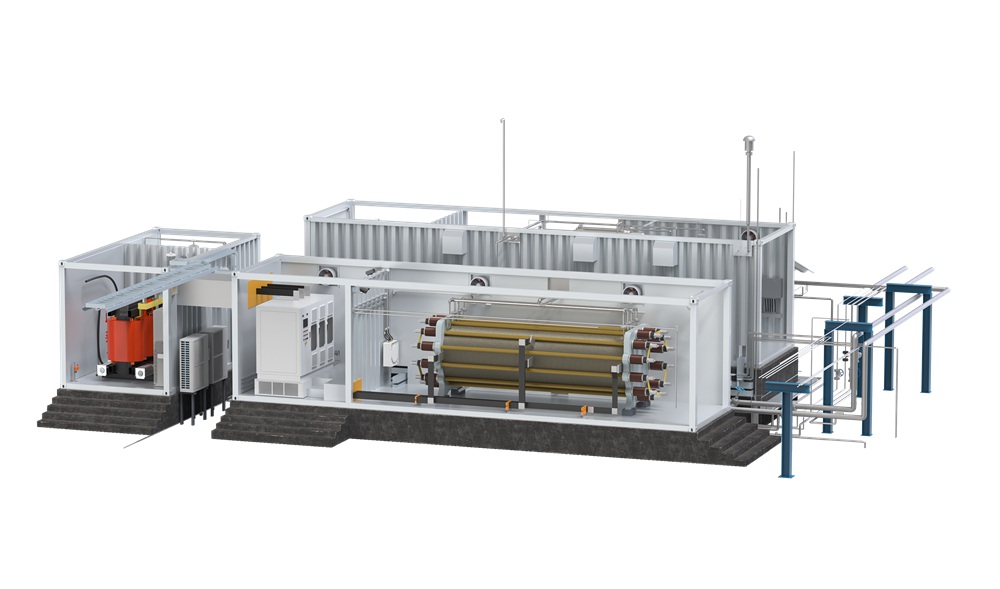
An alkaline electrolyzer system remains one of the most cost-effective and reliable solutions for large-scale hydrogen production. For industries that need stable hydrogen supply, lower long-term operating cost, and MW–GW scalability, alkaline electrolysis continues to be the preferred technology.
At HYVODA, we developed our alkaline electrolyzer system through deep research in electrochemistry, fluid simulation, membrane materials, and industrial automation. As a result, our systems deliver 3.9–4.4 kWh/Nm³ power consumption, 10+ year stack life, and containerized deployment in just one week.
If your project focuses on continuous hydrogen production, renewable energy integration, ammonia, methanol, or industrial gas supply, choosing the right alkaline electrolyzer system directly impacts ROI, safety, and long-term expansion flexibility.
How an Alkaline Electrolyzer System Works in Industrial Hydrogen Projects
An alkaline electrolyzer system uses a 30% KOH electrolyte solution to split purified water into hydrogen and oxygen under DC power.
In HYVODA’s industrial design, the complete process includes:
1) Electrolyzer Stack Reaction
- 5 alkaline electrolyzer units
- 1000 Nm³/h rated hydrogen production
- 500 Nm³/h oxygen production
- 1.6 MPa adjustable pressure
- 90±5°C operating temperature
2) Gas-Liquid Separation
The gas-liquid separation unit processes:
- 5000 Nm³/h hydrogen
- 2500 Nm³/h oxygen
- hydrogen purity ≥99.8%
- oxygen purity >98.5%
3) Hydrogen Purification
The purification section upgrades hydrogen to:
- ≥99.999% purity
- oxygen <5 ppm
- dew point <-70°C
- stable outlet pressure
This makes the HYVODA alkaline electrolyzer system suitable for both industrial gas use and high-purity downstream processes.
Why HYVODA Alkaline Electrolyzer System Delivers Lower Real Operating Cost
Many suppliers focus only on theoretical efficiency. HYVODA focuses on actual field operating conditions.
Our alkaline electrolyzer system achieves:
- 3.9–4.4 kWh/Nm³
- load adjustment 20–110%
- variable capacity control 50% better than traditional systems
- stable frequent start-stop support
Compared with conventional alkaline systems at 4.5–5.5 kWh/Nm³, the energy savings become significant in continuous MW-scale operation.
Lower CAPEX for Large Plants
For projects above 2 MW to GW scale, alkaline systems usually provide the best cost-performance ratio.
This is why they are widely used in:
- green ammonia
- methanol synthesis
- refinery hydrogen
- steel decarbonization
- hydrogen refueling stations
- renewable energy storage
Containerized Alkaline Electrolyzer System: Fast Deployment in 1 Week
One of HYVODA’s strongest competitive advantages is our world-leading containerized alkaline electrolyzer system.
Why Buyers Prefer This Design
- plug-and-play skid connection
- aviation plug electrical design
- no major civil construction
- easy trailer and container transport
- ideal for offshore wind, islands, mountains, and remote industrial sites
Most importantly:
installation time is reduced from 2 months to just 1 week
This dramatically improves project launch speed.
The modular structure also reduces footprint by over 80% compared to traditional peers.
For a 5 MW alkaline electrolyzer system, the footprint is around:
~90㎡ vs 220–250㎡ traditional systems
Advanced Stack Design Makes HYVODA Alkaline Electrolyzer System More Durable
The real value of an alkaline electrolyzer system depends on stack design.
HYVODA integrates:
- electrochemistry
- fluid mechanics
- thermodynamics
- bubble dynamics
- multiphase flow simulation
This simulation-driven engineering improves:
- flow uniformity
- temperature balance
- catalyst utilization
- membrane durability
- current density stability
Core Material Advantages
Our 3rd-generation metal oxide nanoparticle modified PPS membrane offers:
- stronger hydrophilicity
- lower ionic resistance ≤0.3 Ω·cm²
- stable operation at 110°C
- bubble point pressure 200 bar
- enhanced high-temperature stability
Combined with Ni-based catalyst optimization, this extends stack life to:
10+ years before major maintenance
This is a major commercial advantage for long-term industrial hydrogen plants.
Smart IoT Cloud Platform Reduces O&M Cost by 50%
Another major reason customers choose HYVODA is our pioneering IoT big data remote O&M platform.
The platform currently supports:
- monitoring of 100,000+ hydrogen production and refueling units
- preventive maintenance forecasting within 3 months
- mobile and cloud access
- matrix control for 50–500 on-site systems
- unmanned operation support
This reduces maintenance costs by 50% and improves uptime.
For distributed hydrogen production projects, this is a major operational advantage.
Proven Global Projects Validate HYVODA Alkaline Electrolyzer System
HYVODA’s alkaline electrolyzer system has already proven itself in real global projects.
Representative Projects
- 25 MW Ningdong Renewable Carbon Reduction Project
- 2 MW Morocco Green Ammonia Project
- 5 MW Shanghai Grid-Powered Hydrogen Project
These successful deployments demonstrate:
- large-scale engineering capability
- global delivery
- renewable coupling
- high safety standards
- stable industrial operation
HYVODA also maintains:
nearly 20 years of zero-accident safe operation
This level of field proof strongly improves buyer confidence.
Why HYVODA Is the Better Alkaline Electrolyzer System Partner
HYVODA combines U.S.-origin core technology, strong PhD-led R&D, 100+ patents, and global manufacturing capacity up to GW scale.
Customers choose us because we provide:
- lower real power consumption
- 30-year system life
- 10-year stack durability
- fast 1-week deployment
- remote O&M intelligence
- MW–GW matrix hydrogen control
- turnkey EPC integration
- global certification capability
- renewable wind + solar coupling
For serious industrial hydrogen investors, this means:
lower risk, faster ROI, and easier expansion
FAQ: Alkaline Electrolyzer System
1. What is the efficiency of an alkaline electrolyzer system?
HYVODA systems achieve 3.9–4.4 kWh/Nm³ under actual operating conditions.
2. Is alkaline better than PEM for large-scale hydrogen?
Yes. For stable MW-scale continuous production, alkaline systems usually offer lower CAPEX and long service life.
3. How long does the electrolyzer stack last?
HYVODA stack lifetime exceeds 10 years before major maintenance.
4. Can alkaline electrolyzer systems work with renewable energy?
Yes. HYVODA supports GW-scale wind and solar coupled electrolysis clusters.
5. How fast can the system be installed?
Our containerized system can be deployed in as little as 1 week.