
Green hydrogen production cost is one of the most important factors in electrolyzer project planning. Before selecting a system, buyers want to understand the real hydrogen cost per kg, long-term electricity expense, stack replacement cycle, compression cost, and overall return on investment.
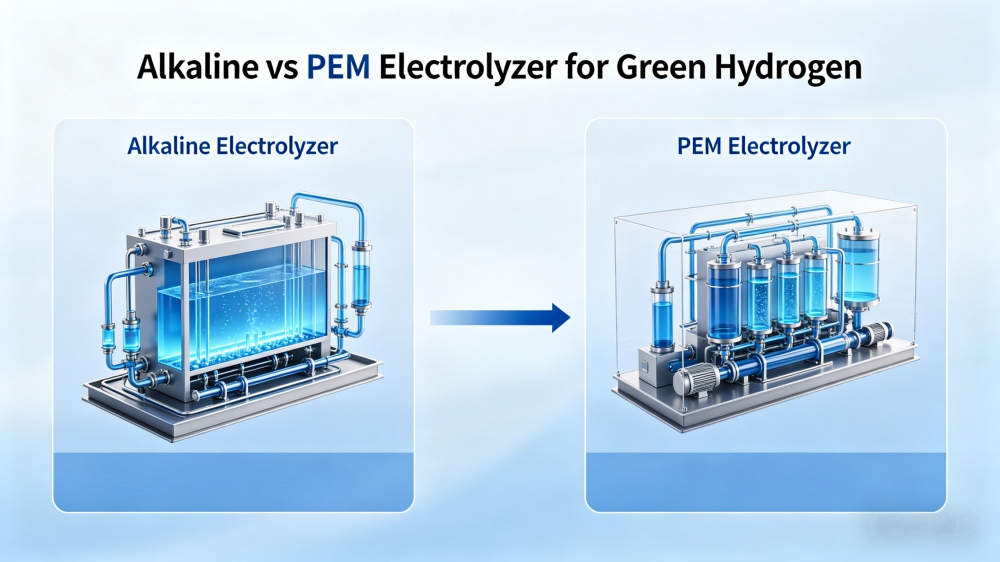
While both alkaline and PEM technologies can produce green hydrogen efficiently, their economics differ significantly depending on load profile, renewable power fluctuation, hydrogen pressure requirements, and downstream use.
At HYVODA, we help customers reduce green hydrogen production cost by combining low real power consumption, long stack life, containerized deployment, and hybrid ALK + PEM architectures that improve renewable utilization.
For projects in ammonia, methanol, refueling, and renewable hydrogen storage, the right cost strategy can directly improve payback speed.
What Determines Green Hydrogen Production Cost?
The total green hydrogen production cost is not based on electricity alone.
A realistic cost model includes:
- electricity consumption
- stack replacement
- compression
- water treatment
- maintenance
- installation schedule
- footprint and land cost
- renewable curtailment loss
- system expansion flexibility
This is why a lower CAPEX system does not always produce the lowest hydrogen cost per kilogram.
Electricity Cost: The Largest Part of Green Hydrogen Production Cost
In most industrial projects, electricity contributes the largest share of green hydrogen production cost.
Under HYVODA actual operating conditions:
HYVODA Alkaline
- 3.9–4.4 kWh/Nm³
- best for stable baseload demand
- excellent for ammonia and methanol
HYVODA PEM
- 3.9–4.5 kWh/Nm³
- stronger for fluctuating renewable power
- better for dynamic load following
When renewable power remains stable, alkaline usually provides the lower green hydrogen production cost.
However, in projects with heavy wind and solar fluctuation, PEM often lowers practical electricity waste by reducing curtailment.
Hydrogen Cost per kg: ALK vs PEM in Real Projects
For real project evaluation, many investors focus on:
cost per kg of hydrogen
When ALK Has Lower Cost per kg
Alkaline usually performs better when:
- hydrogen demand is stable
- operation is 24/7
- plant size exceeds MW scale
- hydrogen feeds chemical synthesis
This is why it remains the preferred route for:
- green ammonia
- methanol synthesis
- refinery hydrogen
- steel decarbonization
When PEM Has Lower Cost per kg
PEM often wins when:
- renewable fluctuation is high
- direct pressure reduces compression
- project values fast response
- hydrogen serves mobility applications
The best answer depends on load profile, not only stack efficiency.
Compression Cost Changes the Real ROI
Many buyers underestimate hydrogen compression cost.
This is where HYVODA PEM systems create a strong economic advantage.
Our PEM systems support:
3.5 MPa direct hydrogen output
This reduces:
- compressor CAPEX
- power consumption
- maintenance cost
- auxiliary footprint
For:
- hydrogen refueling
- trailer filling
- distributed hydrogen hubs
- mobility stations
PEM often lowers total project cost even if initial electrolyzer CAPEX is higher.
Stack Replacement and Lifetime Cost
Long-term lifecycle cost strongly affects green hydrogen production cost.
HYVODA Alkaline Advantage
- 10+ year stack life
- 30-year system life
- easier batch maintenance
- lower replacement frequency
This gives alkaline a strong lifecycle advantage in large continuous hydrogen plants.
HYVODA PEM Advantage
- faster response
- stronger renewable flexibility
- lower compression dependence
- higher value in mobility hydrogen
The right economic choice depends on whether your project values long service life or flexibility premium.
How Containerized Deployment Reduces Hydrogen Cost Faster
Deployment speed directly impacts ROI.
HYVODA’s containerized alkaline electrolyzer system reduces installation time from:
2 months → 1 week
This creates cost advantages through:
- faster hydrogen revenue generation
- lower labor cost
- reduced EPC uncertainty
- minimal civil construction
- earlier project commissioning
In many commercial cases, faster deployment shortens payback more than small efficiency differences.
Best ROI for Green Ammonia and Methanol Projects
For projects focused on:
- ammonia synthesis
- methanol production
- chemical hydrogen feedstock
- refinery hydrogen
hydrogen demand remains stable and continuous.
This strongly favors:
ALK lower CAPEX + long stack life + stable baseload
That is why HYVODA’s Morocco Green Ammonia Project and Ningdong 25 MW project both use alkaline systems.
For chemical projects, alkaline usually creates the best green hydrogen production cost.
Hybrid ALK + PEM Strategy Often Creates the Lowest Green Hydrogen Production Cost
This is one of HYVODA’s strongest commercial advantages.
Instead of choosing only one technology, we often design:
ALK + PEM hybrid renewable hydrogen clusters
Why This Lowers Total Cost
- ALK handles baseload hydrogen
- PEM absorbs renewable fluctuation peaks
- reduces curtailment loss
- lowers oversizing risk
- balances CAPEX and dynamic flexibility
For large wind + solar hydrogen hubs, this hybrid design often creates the best long-term ROI.
How HYVODA Helps Customers Improve Project Payback
HYVODA improves green hydrogen production cost through:
- low real power consumption
- 10+ year stack durability
- 1-week modular deployment
- 80% smaller footprint
- 3.5 MPa PEM direct pressure
- remote IoT predictive maintenance
- MW–GW matrix scheduling
- global EPC integration
This allows customers to optimize:
- cost per kg
- payback period
- renewable absorption
- future expansion
- hydrogen delivery pressure
- long-term O&M
FAQ
1. What is the biggest factor in green hydrogen production cost?
Electricity cost is usually the largest factor, followed by stack lifecycle and compression.
2. Which is cheaper for ammonia projects, ALK or PEM?
ALK is usually more cost-effective for stable ammonia and methanol production.
3. Does PEM reduce downstream compression cost?
Yes. HYVODA PEM systems can output hydrogen at 3.5 MPa, reducing compression needs.
4. How does containerization improve ROI?
It cuts installation time from months to about 1 week, accelerating revenue generation.
5. Can hybrid ALK + PEM reduce hydrogen cost?
Yes. It improves renewable utilization and often lowers total hydrogen cost.